
How to Buy a Used ASIC Miner in 2026: A Practical Checklist for Mining Operators

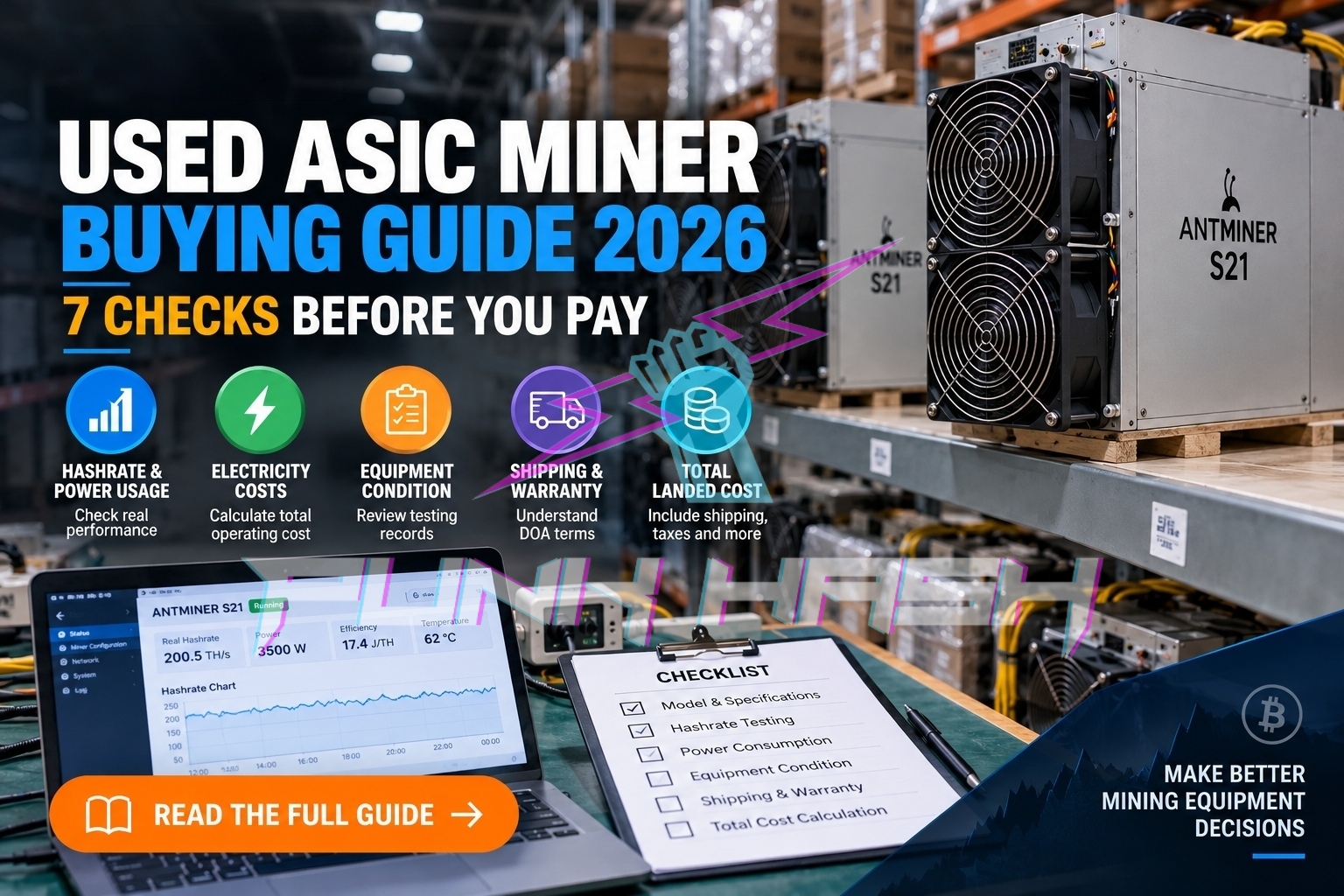
How to Buy a Used ASIC Miner in 2026: A Practical Checklist for Mining Operators
A lower price doesn’t always mean a better mining investment. Here’s how to evaluate used Bitcoin mining equipment before making a purchase.
Buying used ASIC miners can be a practical way to expand mining capacity without paying the full price of brand-new equipment.
However, not every used miner is a good deal.
Two machines with identical advertised hashrates may have different power consumption, operating histories, repair conditions, and long-term maintenance costs.
For mining operators, the real question is not simply:
“How much does this miner cost per TH?”
A better question is:
“What will this machine actually cost to purchase, operate, and maintain?”
This guide explains seven important checks every buyer should complete before purchasing used ASIC mining equipment.
1. Calculate Electricity Costs Before Comparing Miner Prices
Electricity is one of the largest ongoing costs in Bitcoin mining.
Before purchasing a used ASIC miner, confirm three numbers:
- Actual hashrate in TH/s
- Power consumption at the wall in watts
- Your site’s all-in electricity price per kWh
You can calculate daily electricity costs using:
Daily Electricity Cost = Power Consumption (kW) × 24 × Electricity Rate ($/kWh)
For example, consider two hypothetical miners delivering the same 200 TH/s:
| Especificações | Miner A | Miner B |
|---|---|---|
| Hashrate | 200 TH/s | 200 TH/s |
| Eficiência | 20 J/TH | 30 J/TH |
| Power consumption | 4,000 W | 6,000 W |
| Daily electricity at $0.06/kWh | $5.76 | $8.64 |
| Monthly electricity (30 days) | $172.80 | $259.20 |
Miner B consumes an additional $86.40 in electricity per month, despite delivering the same hashrate.
Over 12 months of continuous operation, that difference would be approximately $1,036.80.
These figures are illustrative and exclude cooling, downtime, maintenance, and other operating costs.
Buyer takeaway: Always compare mining equipment using both purchase price and power efficiency.
2. Verify the Exact Model and Specifications
ASIC miner model names can be confusing.
Even within the same product family, different versions may have different hashrates, power requirements, and cooling systems.
Before placing an order, ask the supplier to confirm:
- Manufacturer and exact model
- Rated hashrate and power consumption
- Air-cooled, hydro-cooled, or immersion configuration
- Input voltage and electrical requirements
- Firmware version
- Serial number, where available
- Physical condition and included accessories
For example, an Antminer S21, S21 Pro, and S21 XP should not be treated as interchangeable products.
Their performance, efficiency, and market pricing can differ significantly.
Buyer takeaway: Never rely on a product family name alone. Verify the exact model and configuration.
3. Request Real Testing Evidence Before Payment
A product listing tells you what a machine is supposed to do.
A recent operating test helps show what that specific machine is actually doing.
For used ASIC miners, buyers should request available testing evidence such as:
Hashrate dashboard
Check whether the machine is operating near the expected performance range under the stated conditions.
Hashboard status
Verify that the expected hashboards are detected and functioning.
Temperature readings
Review chip and board temperatures for signs of overheating or abnormal operation.
Power consumption
Where possible, request measured wall power rather than relying only on factory specifications.
Running video
Ask for a recent video showing the equipment operating, preferably linked to the unit or batch being offered.
Serial number records
For larger purchases, request an agreed method for verifying and recording serial numbers.
A short video or screenshot does not guarantee long-term reliability, but it provides more evidence than a product photo alone.
Buyer takeaway: Ask what was tested, how long it was tested, and whether the evidence belongs to the equipment being purchased.
4. Understand the Difference Between Used, Refurbished, and Repaired Miners
Not all used ASIC miners have the same history.
A machine may be:
- Used and currently operating
- Used and recently removed from a mining facility
- Previously repaired
- Refurbished with replacement components
- Stored for an extended period
- Untested or sold as-is
These conditions can affect price, reliability, and warranty terms.
A repaired miner is not automatically a bad purchase.
However, buyers should understand what was repaired, which parts were replaced, and whether the machine has been tested afterward.
Useful questions include:
Has the hashboard been repaired?
Has the power supply been replaced?
Has the machine been operated with custom firmware or overclocked?
Are there any known recurring faults?
Buyer takeaway: Equipment history should be disclosed as clearly as possible. If the seller cannot verify the history, treat it as an additional purchasing risk.
5. Calculate the Total Landed Cost
The quoted miner price is not necessarily the final amount you will pay.
Depending on the shipment and destination, additional costs may include:
- International or domestic freight
- Customs duties and taxes
- Customs brokerage and handling fees
- Cargo insurance
- Electrical accessories
- Cooling and installation costs
- Inspection and repair expenses
Consider this hypothetical example:
| Cost Item | Amount |
|---|---|
| Used ASIC miner | $800 |
| Shipping | $120 |
| Import charges | $80 |
| Initial maintenance allowance | $50 |
| Total estimated landed cost | $1,050 |
The equipment was advertised for $800, but the estimated total acquisition cost is $1,050.
These are illustrative amounts, not a shipping quotation or a statement of applicable taxes.
Buyer takeaway: Compare suppliers using the total delivered cost under the same commercial terms, not only the equipment price.
6. Confirm DOA, Warranty, and Shipping Terms in Writing
Before sending payment, buyers should understand what happens if a miner arrives damaged or fails to operate.
DOA means Dead on Arrival, but the definition and coverage can vary by supplier.
Important questions include:
Is DOA coverage included?
How many days does the buyer have to report a problem?
What evidence is required to make a claim?
Are replacement parts, repairs, or replacement units available?
Who pays for return shipping?
Is cargo insurance included or optional?
When does responsibility for the shipment transfer to the buyer?
A seven-day DOA policy, for example, should not automatically be interpreted as a seven-day unconditional refund policy.
The exact remedies and exclusions must be confirmed.
For large orders, buyers should also clarify warehouse inspection arrangements and whether independent testing is permitted.
Buyer takeaway: Get the terms in writing before payment, particularly for used equipment and international shipments.
7. Evaluate Profitability Using Your Own Mining Conditions
Online mining calculators are useful, but they cannot predict future mining revenue with certainty.
Bitcoin mining economics change with:
- BTC market price
- Dificuldade de rede
- Taxas de transação
- Mining pool fees
- Electricity rates
- Actual operating uptime
- Maintenance and repair costs
A simplified calculation is:
Estimated Daily Electricity-Only Margin = Daily Mining Revenue − Daily Electricity Cost
A more complete operating calculation also deducts pool fees, cooling, hosting, maintenance, and other costs.
To evaluate an equipment purchase, consider the full acquisition cost and possible future changes in revenue.
For example, test what happens if:
- Mining revenue falls by 20%
- Electricity prices increase
- Equipment uptime decreases
- An unexpected repair is required
If the purchase only makes sense under the most optimistic assumptions, the buyer should reconsider the risk.
Buyer takeaway: A good mining equipment decision should remain understandable under both favorable and unfavorable scenarios.
Used ASIC Miner Buying Checklist
Before paying for used mining equipment, use the following checklist:
| Artigo | What to Verify |
|---|---|
| Exact model | Manufacturer, model, variant |
| Hashrate | Rated and recently tested TH/s |
| Power efficiency | Wall power and J/TH |
| Equipment condition | Used, repaired, refurbished, or as-is |
| Test evidence | Dashboard, running video, logs |
| Serial numbers | Identity and batch traceability |
| Electricity compatibility | Voltage, power, cooling |
| Shipping | Origin, destination, freight terms |
| Warranty / DOA | Coverage, exclusions, claim process |
| Custo total | Equipment, shipping, taxes, setup |
You can copy this checklist and use it when requesting quotations from any ASIC miner supplier.
Perguntas Frequentes
Is buying a used ASIC miner worth it in 2026?
It depends on the purchase price, electricity cost, machine efficiency, equipment condition, and expected operating period. A used miner can be cost-effective when its lower acquisition cost outweighs its additional operating and maintenance risks.
What should I check before buying a used Antminer?
Verify the exact model, serial number, hashboard condition, operating test results, firmware, power consumption, and written after-sales terms.
How do I compare two ASIC miners with different hashrates?
Compare purchase cost per TH/s, power efficiency in J/TH, daily electricity expense, expected operating uptime, and total acquisition cost. Do not compare total machine price alone.
What is a good electricity rate for Bitcoin mining?
There is no universally profitable electricity rate. The break-even point changes with miner efficiency, hashprice, network difficulty, pool fees, and other operating costs.
Can I request a running video before purchasing used ASIC miners?
Yes. Buyers can request recent running videos, dashboard screenshots, or other testing records. Availability and the scope of testing should be confirmed with the seller.
Does every used ASIC miner include DOA coverage?
No. DOA and warranty conditions vary by seller, warehouse, batch, and transaction. Always confirm the applicable terms before payment.
Final Thoughts: Buy Based on Evidence, Not Just Price
The cheapest ASIC miner is not always the best deal.
A good purchase decision considers equipment efficiency, operating condition, electricity cost, logistics, and after-sales support.
For buyers, asking better questions before payment can reduce the risk of unexpected expenses later.
For suppliers, providing clear information and realistic expectations helps build stronger long-term relationships.
At PunkHash, we believe mining equipment buyers should have the information they need to compare options and make informed decisions.
If you’re evaluating used Antminer or WhatsMiner equipment, our team can discuss available stock, equipment specifications, testing arrangements, and shipping options.
Explore ASIC mining equipment and components:
Request equipment availability or a quotation:
Contacte a PunkHash pelo WhatsApp
When contacting us, please include your preferred model, quantity, destination, and electricity rate.
Better information leads to better mining equipment decisions.