
AI Data Center Infrastructure: 7 Essential Hardware Systems

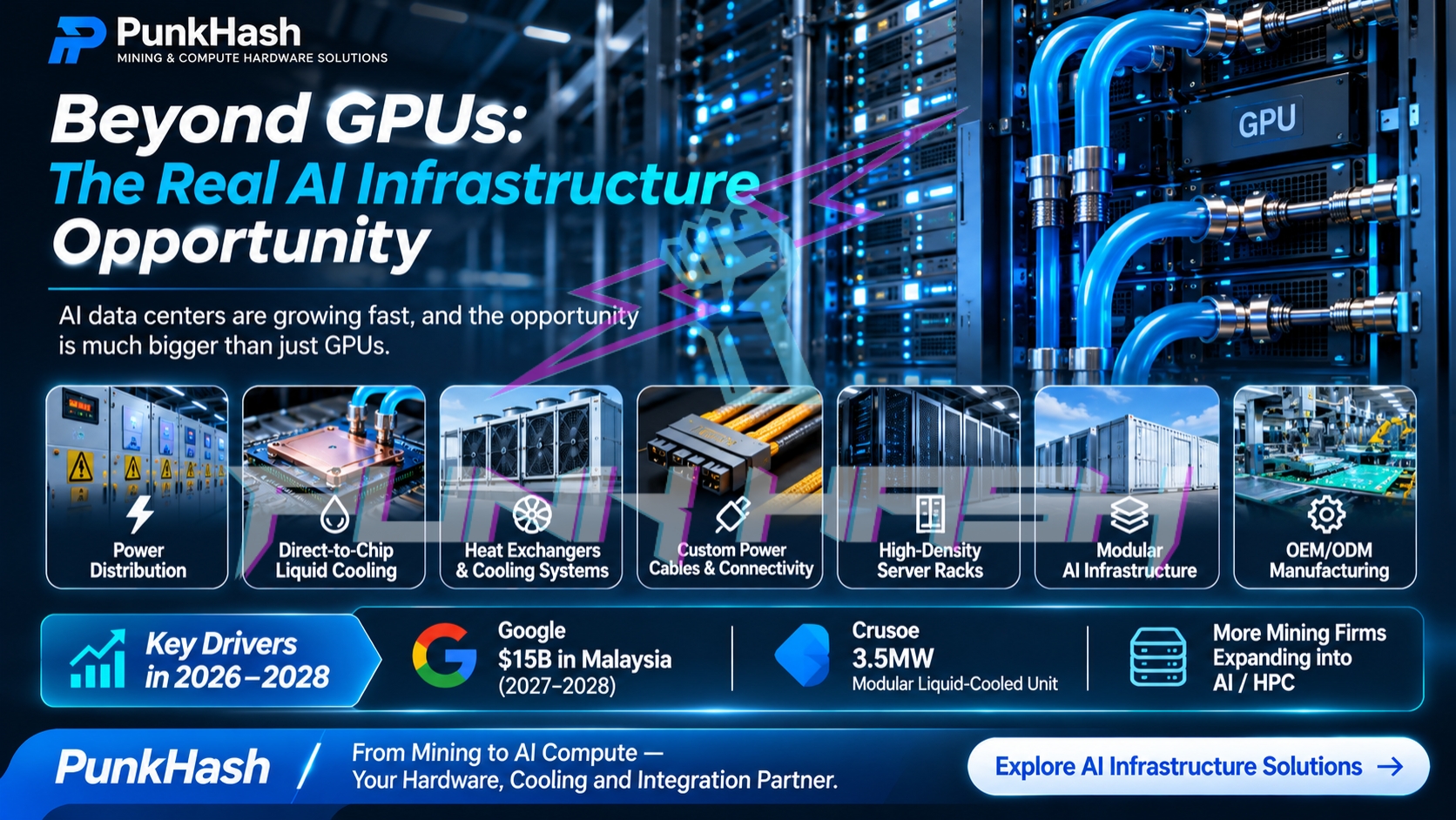
Beyond GPUs: 7 Essential Hardware Systems for AI Data Centers
Why power, cooling, connectivity, and modular infrastructure matter as much as computing hardware.
Artificial intelligence is creating new demand for computing infrastructure worldwide.
On November 4, 2026, Google announced plans to invest $15 billion in Malaysia during 2027 and 2028. The investment covers data center development, clean energy, water infrastructure, and workforce development.
Meanwhile, Crusoe has introduced Spark Liquid, a modular, liquid-cooled AI infrastructure platform designed to support up to 3.5MW of computing capacity per unit.
These developments highlight an important shift in the AI hardware industry.
Building AI computing capacity is no longer just about purchasing GPUs.
It also requires reliable electrical systems, efficient thermal management, high-density racks, custom connectivity, and carefully integrated infrastructure.
For data center developers, system integrators, and AI hardware manufacturers, these supporting systems represent important engineering and procurement challenges.
In this guide, we explore seven essential hardware systems behind modern AI data centers.
1. Power Distribution: The Foundation of AI Computing
High-performance AI servers require reliable and appropriately designed power infrastructure.
Depending on the project, this may involve:
- Power distribution units (PDUs)
- Electrical switchgear and distribution panels
- High-current power connectors
- Custom power cables and wiring harnesses
- Power monitoring and protection systems
- Backup power and electrical redundancy
AI computing environments may have different power density, availability, and redundancy requirements from traditional cryptocurrency mining facilities.
Before specifying power components, buyers should confirm:
- Total IT load and expected expansion
- Input voltage and phase configuration
- Rack-level power requirements
- Connector specifications
- Electrical protection and redundancy
- Applicable local safety and certification requirements
A cable or connector that works in one computing environment is not automatically suitable for another.
Correct electrical engineering and component qualification are essential.
2. Direct-to-Chip Liquid Cooling
As AI computing density increases, thermal management becomes a central infrastructure challenge.
Direct-to-chip liquid cooling transfers heat from processors through liquid-cooled cold plates.
A typical system may include:
- GPU and CPU cold plates
- وحدات توزيع سائل التبريد (CDUs)
- Pumps and valves
- Heat exchangers
- Liquid manifolds
- Hoses and quick-disconnect fittings
- Temperature, pressure, and flow sensors
Liquid cooling can support higher heat densities than conventional air cooling in suitable designs.
However, the correct solution depends on server architecture, heat load, facility water conditions, maintenance requirements, and overall system design.
What Should Buyers Verify?
Before selecting liquid cooling components, confirm:
- Supported GPU or CPU platform
- Required thermal performance
- Coolant compatibility
- Operating pressure and flow rate
- Material and seal compatibility
- Leak detection and maintenance requirements
- Mechanical fit and connector specifications
These parameters should be validated against the actual hardware configuration.
3. Heat Exchangers and External Cooling Systems
Removing heat from a GPU is only the first part of the cooling process.
That heat must also be transferred away from the computing environment.
Depending on the project, external cooling infrastructure may include:
- Plate heat exchangers
- Dry coolers
- Chillers
- Cooling distribution equipment
- Pumps and control systems
- Heat recovery equipment
The correct design depends on ambient conditions, facility water temperature, cooling capacity, and local resource constraints.
For example, a project in a hot and humid region may require a different cooling approach from one in a cooler climate.
System selection should be based on engineering calculations rather than a generic cooling capacity claim.
4. Custom Power Cables and Connectivity
Power and signal connectivity are often overlooked during early project planning.
However, incompatible connectors, incorrect wire sizing, or poor cable routing can create installation delays and reliability problems.
AI hardware projects may require:
- Custom-length power cables
- High-current connector assemblies
- Server rack wiring harnesses
- Control and monitoring cables
- Specialized adapter assemblies
- Cable identification and traceability
For OEM/ODM projects, buyers should provide connector drawings, electrical ratings, cable lengths, environmental conditions, and expected quantities.
Where applicable, assemblies should undergo electrical, mechanical, and safety testing before deployment.
Important: Custom adapters must never be selected solely because connectors appear physically compatible. Voltage, current, pin assignments, grounding, and protection requirements must all be verified.
5. High-Density Server Racks and Enclosures
AI infrastructure requires more than standard equipment shelving.
Rack integration can involve:
- Structural load capacity
- توزيع الطاقة
- Cooling manifolds
- Cable management
- Service access
- Monitoring systems
- Physical security
- Transport and installation requirements
The rack design must match the server configuration and operating environment.
For high-density liquid-cooled systems, mechanical and thermal integration should be evaluated together.
6. Modular and Prefabricated AI Infrastructure
Modular data centers are becoming an important deployment option for certain AI workloads.
Instead of assembling every component at the final site, suppliers can integrate and test selected infrastructure systems in a controlled manufacturing environment.
This approach can help reduce on-site integration work and improve consistency.
Crusoe’s Spark Liquid platform is one recent example of the industry’s direction. The company says its modular system is designed to support up to 3.5MW of compute per unit, with closed-loop liquid cooling for high-density AI racks.
However, modular infrastructure still requires site-specific engineering.
Projects must account for:
- السعة الكهربائية المتاحة
- Cooling and environmental conditions
- Site access and structural requirements
- Network connectivity
- Local permitting
- Fire protection and safety
- Commissioning and maintenance
A prefabricated module is not a substitute for a properly prepared site.
7. OEM/ODM Manufacturing and System Integration
Not every AI hardware company wants to manufacture every component internally.
Many projects require specialized suppliers for custom mechanical, electrical, and thermal components.
Potential OEM/ODM requirements include:
- Custom cold plates
- Cooling assemblies
- Power cable harnesses
- Connectors and adapters
- Mechanical enclosures
- PCB and control board development
- Prototype assembly
- Testing and manufacturing coordination
For these projects, engineering communication is often as important as unit pricing.
A useful supplier should understand specifications, validation requirements, lead times, quality expectations, and production quantities.
Can Bitcoin Mining Infrastructure Be Reused for AI Data Centers?
This is an increasingly important question as some mining operators explore AI and high-performance computing opportunities.
Mining facilities and AI data centers share certain infrastructure categories:
- Electrical power distribution
- Cooling equipment
- Industrial enclosures
- Equipment installation
- Monitoring and maintenance
However, their technical requirements can differ substantially.
| البنية التحتية | التعدين باستخدام ASIC | AI Data Centers |
|---|---|---|
| Electrical systems | Optimized for mining hardware | Server-specific power, protection, and availability requirements |
| التبريد | Air, hydro, or immersion | Air, direct liquid cooling, or hybrid designs |
| Networking | Relatively modest bandwidth requirements | Potentially demanding low-latency, high-bandwidth networks |
| Racks | Mining-specific layouts | Server-specific mechanical and service requirements |
| التوافر | Depends on mining economics | Often driven by workload and service-level requirements |
| Deployment | Mining farm integration | Integrated compute, storage, network, and cooling infrastructure |
Experience in mining infrastructure can provide useful engineering and supply chain knowledge.
But converting a mining site into an AI facility requires a separate technical and commercial feasibility assessment.
How PunkHash Supports Mining and AI Hardware Infrastructure
PunkHash has experience in ASIC mining hardware sourcing, hydro-cooling systems, custom components, and infrastructure integration.
As the AI hardware market expands, we are extending our focus toward relevant B2B hardware and OEM/ODM opportunities.
Our areas of interest and supply-chain support include:
Cooling Components
GPU cooling cold plates, heat exchangers, dry coolers, and related liquid-cooling components.
Custom Electrical Components
Power cables, connector assemblies, wiring harnesses, and project-specific electrical accessories.
Hardware OEM/ODM
Custom component development, prototyping, manufacturing coordination, and engineering collaboration.
Infrastructure Integration
Mining infrastructure solutions and selected modular computing infrastructure components.
Specific compatibility, certification, production capacity, testing arrangements, and delivery commitments must be confirmed for each project.
Our approach is to start with the customer’s actual technical requirements and identify practical sourcing or manufacturing solutions.
الأسئلة الشائعة
What is AI data center infrastructure?
AI data center infrastructure includes the electrical, cooling, networking, mechanical, and operational systems required to support AI computing hardware.
Why is liquid cooling important for AI servers?
Liquid cooling can help manage the high heat densities associated with certain modern processors and server configurations. Its suitability depends on the complete system design.
Can existing Bitcoin mining containers be converted into AI data centers?
Some components or engineering approaches may be reusable, but conversion requires an assessment of power, cooling, networking, structural, safety, and availability requirements.
What information is needed for a custom GPU cooling project?
Buyers should provide the hardware model, mechanical drawings where available, thermal requirements, coolant specifications, operating pressure, flow requirements, quantity, and expected timeline.
Can AI hardware companies outsource custom components?
Yes. OEM/ODM suppliers can support custom mechanical, electrical, thermal, and electronic components, subject to engineering validation and manufacturing capabilities.
Conclusion: AI Infrastructure Is More Than GPUs
The global expansion of AI computing is creating demand across the entire hardware supply chain.
GPUs may attract the most attention, but reliable computing infrastructure depends on power distribution, cooling, connectivity, enclosures, and manufacturing quality.
For AI hardware companies and system integrators, selecting the right supporting components can be as important as selecting the computing hardware itself.
The future of computing depends not only on faster processors, but also on the infrastructure that keeps them running.
Looking for Custom AI Hardware Components?
PunkHash welcomes discussions with AI hardware companies, data center integrators, and OEM/ODM partners.
Share your project requirements, specifications, expected quantity, and destination so we can evaluate suitable hardware sourcing or customization options.
الموقع الإلكتروني: https://www.punkhash.com/
WhatsApp: https://wa.me/85293158482
PunkHash — Compute the Future Together.
Industry References
- Google, November 4, 2026: https://www.googlecloudpresscorner.com/2026-11-04-Google-Announces-Digital-Infrastructure-Expansion-Local-Jobs-Water-Replenishment-and-Clean-Energy-Initiatives-with-US-15-Billion-Malaysia-Investment
- Crusoe, October 21, 2026: https://www.crusoe.ai/resources/newsroom/crusoe-introduces-crusoe-spark-liquid









El creciente requerimiento de infraestructura, como se ve en las inversiones globales en centros de datos, resalta la importancia de analizar el valor empresarial real. Para entender cómo sostener tales proyectos a largo plazo, herramientas como business quality research pueden ayudar a identificar ventajas competitivas sólidas más allá del capital físico. business quality research
Gracias por compartir tu perspectiva. Coincidimos en que, para evaluar el valor a largo plazo de un centro de datos, hay que mirar más allá de la inversión inicial. El acceso estable a la energía, la eficiencia de la refrigeración y la capacidad de operar y ampliar la infraestructura también pueden convertirse en ventajas competitivas duraderas. ¿Cuál de estos factores consideras más decisivo al evaluar un proyecto?
데이터센터 인프라처럼 규모가 커지는 시스템도 결국 사람과 반려동물의 일상을 담는 작업과 닮아 있네요. 사진 한 장에서 시작해 owner and pet portraits 같은 결과물로 이어지는 과정도 비슷한 결이 있습니다. owner and pet portraits
Interessanter Artikel über die Infrastruktur hinter KI-Rechenzentren. Die Verbindung von Energie, Kühlung und Konnektivität wird oft unterschätzt, während der Fokus meist nur auf der Rechenleistung liegt. Die Ankündigung von Google für Malaysia zeigt, wie stark der Bedarf an solcher Infrastruktur weltweit wächst. free photo eraser
Great overview of the infrastructure needs. The AI Sticker Maker actually uses similar GPU resources in the cloud to process images like this, so understanding data center growth is relevant. AI Sticker Maker
Aplicações de IA como SuperResolution Online destacam a crescente demanda por infraestrutura robusta discutida aqui. SuperResolution Online