
Industrial Edge AI Hardware Sourcing Guide for OEMs

Industrial Edge AI Hardware Sourcing: 7 Questions OEM Buyers Should Ask Before Production
A practical guide to choosing AI computing modules, industrial AI boxes, carrier boards, cooling solutions, and hardware manufacturing partners.
Introduction: Edge AI Is Becoming an Industrial Hardware Opportunity
Edge AI is moving beyond research laboratories and development boards.
From industrial machine vision and autonomous robots to smart cameras and factory automation, more companies are exploring ways to run AI workloads directly on local devices.
At electronica 2026, held in Munich from November 10–13, embedded computing and Edge AI are important themes.
For example, SECO is showcasing its SOM-SMARC-Dragonwing-IQ8 module, based on Qualcomm Dragonwing IQ8 technology. The platform illustrates how modular computing hardware, software tools, and lifecycle support can help developers move from prototypes toward commercial products.
But for industrial OEMs, selecting an AI processor is only the beginning.
A successful product also requires reliable power, thermal management, software compatibility, industrial connectivity, component availability, and consistent manufacturing.
Before choosing an Edge AI hardware supplier, OEM buyers should ask seven important questions.
1. What Type of Edge AI Hardware Does Your Application Actually Need?
Not every industrial AI application requires the same hardware architecture.
Three common product categories are worth comparing.
AI Development Boards
Development boards are designed primarily for evaluation, prototyping, and software development.
They help engineers test AI models, evaluate processing performance, and connect peripherals before committing to a final hardware design.
Common development ecosystems include NVIDIA Jetson, Rockchip RK3588, and Qualcomm Dragonwing.
However, a development board is not automatically suitable for long-term industrial deployment.
System-on-Module (SoM)
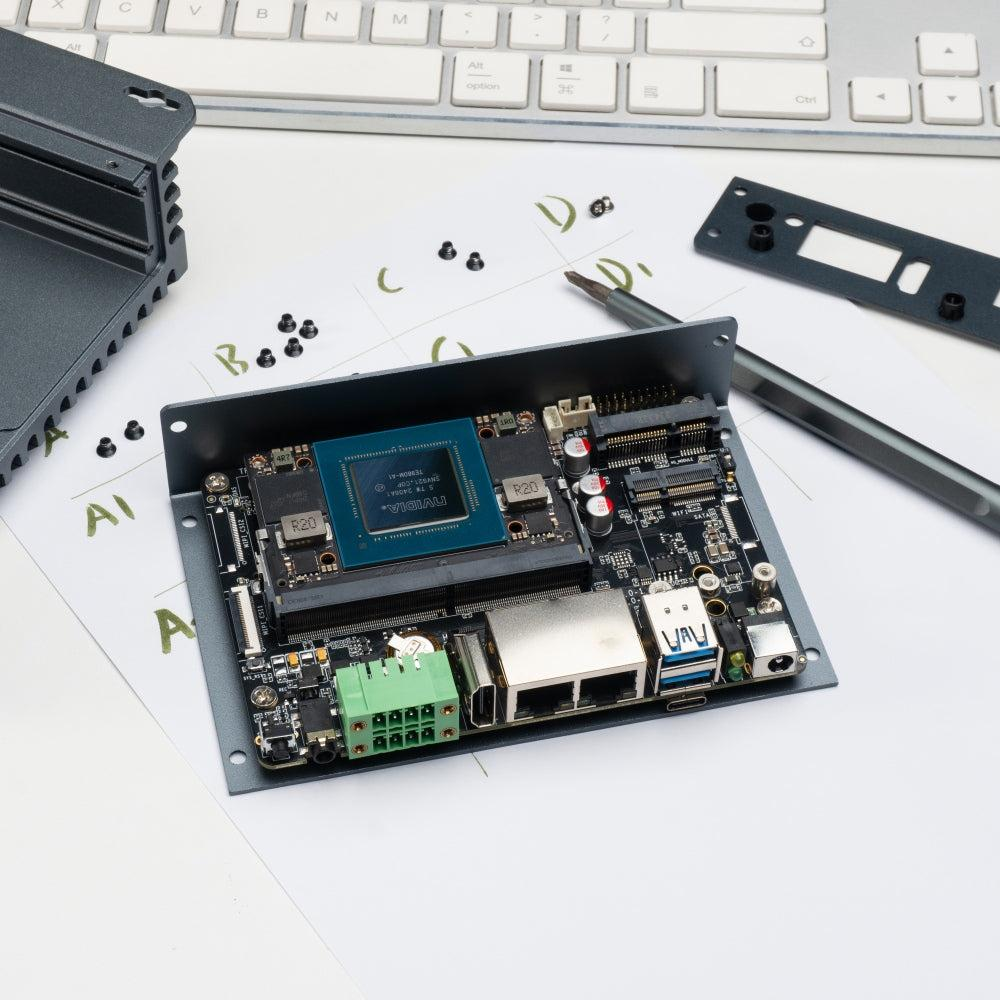
A System-on-Module typically integrates a processor, memory, and supporting circuitry into a compact computing module.
It can be connected to a carrier board designed around the customer’s application.
This approach may help manufacturers reduce hardware development complexity while retaining flexibility over interfaces and mechanical integration.
Industrial Edge AI Boxes
An industrial AI box combines computing hardware with an enclosure, power system, connectivity, and thermal management.
Depending on its configuration, it may support applications such as:
- Machine vision and quality inspection
- Smart cameras and video analytics
- Autonomous mobile robots
- Industrial monitoring
- Intelligent retail systems
- Edge gateways and local AI inference
OEM sourcing tip: Define your application, expected production volume, and deployment environment before choosing between a development board, SoM, or complete AI box.
2. Is the AI Computing Platform Suitable for Your Software?
AI hardware specifications can be misleading when evaluated without software requirements.
A processor may advertise impressive TOPS performance but still be unsuitable for a particular AI model or deployment environment.
OEM buyers should evaluate the complete software ecosystem.
NVIDIA Jetson
Jetson platforms are commonly considered for GPU-accelerated AI, robotics, and computer vision applications.
Buyers should verify JetPack support, operating system compatibility, software dependencies, and the lifecycle of the selected module.
Rockchip RK3588
RK3588-based boards and modules are used in embedded computing and certain edge AI applications.
Important evaluation factors include NPU model support, Linux or Android BSP availability, camera interfaces, and industrial I/O requirements.
Qualcomm Dragonwing
Qualcomm Dragonwing platforms address industrial, robotics, and intelligent device applications.
Its ecosystem includes development hardware, software tools, and computing platforms designed to support the transition from prototyping toward commercial deployment.
Hailo AI Accelerators
Hailo accelerators provide dedicated inference capabilities for supported workloads.
When evaluating an accelerator, buyers should confirm model compatibility, numerical precision, memory requirements, and the availability of deployment tools.
OEM sourcing tip: Ask suppliers to demonstrate your actual AI model on the proposed hardware instead of relying only on advertised TOPS figures.
3. Can the Hardware Support Industrial Connectivity?
Industrial products often require interfaces that are not available on standard development boards.
Depending on the application, requirements may include:
- Gigabit or multi-gigabit Ethernet
- USB connectivity
- CAN or CAN-FD
- RS-232 or RS-485
- GPIO
- Camera interfaces such as MIPI CSI
- PCIe expansion
- Digital input and output
- Conectores de alimentação industriais
For robotics, the computing platform may also need to communicate with motor controllers, sensors, navigation systems, and industrial networks.
A custom carrier board can provide application-specific interfaces while allowing the OEM to use an established computing module.
However, the final interface design must be validated against the selected SoM’s electrical specifications, software drivers, and environmental requirements.
OEM sourcing tip: Provide a complete interface list when requesting a quotation. Include connector types, port quantities, communication protocols, and any isolation requirements.
4. How Will the Device Handle Power and Heat?
Power and thermal design are critical for industrial Edge AI devices.
AI workloads may create sustained processing loads that generate significant heat.
If the thermal system is inadequate, the device may reduce performance, become unstable, or experience reliability problems.
Power Design
Important considerations include:
- Input voltage range
- Peak and sustained power consumption
- Power protection
- Grounding
- Connector ratings
- Cable and wiring harness specifications
- Industrial power supply compatibility
Gestão térmica
Depending on the computing platform and environment, possible cooling methods include:
- Passive aluminum heatsinks
- Heat pipes
- Active cooling fans
- Thermal interface materials
- Custom metal enclosures
- Application-specific liquid cooling for suitable higher-power systems
A compact fanless industrial computer may require a different thermal design from a high-performance robotics platform.
OEM sourcing tip: Request thermal validation under realistic workloads and ambient temperatures, not only laboratory idle conditions.
5. Can the Supplier Support Long-Term Production?
For industrial OEMs, the lowest initial hardware price is not always the lowest total cost.
A product may remain in service for many years.
If a computing module becomes unavailable or its software support ends unexpectedly, the manufacturer may need to redesign the entire device.
Before selecting a supplier, ask about:
- Product lifecycle and expected availability
- Component end-of-life notifications
- Long-term software maintenance
- Replacement and revision management
- Minimum order quantities
- Lead times and production capacity
- Warranty and technical support arrangements
The supplier should also explain how hardware revisions and component substitutions are controlled.
OEM sourcing tip: Request lifecycle documentation and supply continuity information before committing to a production design.
6. What OEM/ODM Customization Services Are Available?
A complete industrial Edge AI product often requires more than a standard computing module.
Depending on the project, customization may include:
Carrier board design: Adapting computing modules to application-specific interfaces and power requirements.
Enclosure manufacturing: Designing mechanical housings for installation, cooling, protection, and serviceability.
Power and wiring: Preparing suitable power cables, connectors, and wiring harnesses.
Thermal components: Developing heatsinks, fans, mounting hardware, and other cooling solutions.
Hardware sourcing: Coordinating the procurement of computing modules, components, and supporting accessories.
Assembly and testing: Establishing functional testing procedures and production quality requirements.
Not every hardware supplier provides all these capabilities internally.
OEM buyers should verify whether services are performed in-house, through manufacturing partners, or through external engineering providers.
OEM sourcing tip: Request a clear breakdown of responsibilities for design, component sourcing, testing, certifications, and after-sales support.
7. What Information Should You Include in an Edge AI Hardware RFQ?
A detailed request for quotation can significantly improve communication between buyers and suppliers.
Before contacting a hardware manufacturer, prepare the following information.
| Requirement | Information to Provide |
|---|---|
| Candidatura | Robotics, machine vision, industrial monitoring, etc. |
| Computing platform | Jetson, RK3588, Qualcomm, Hailo, Intel, or open to suggestions |
| AI workload | Model type, performance target, latency |
| Operating system | Linux, Android, Windows IoT, or other |
| Camera requirements | Number, resolution, interface |
| Conectividade | Ethernet, USB, CAN, serial, wireless |
| Power requirements | Input voltage and estimated consumption |
| Operating environment | Temperature, dust, vibration, installation |
| Mechanical design | Dimensions, enclosure, mounting |
| Production quantity | Samples, pilot batch, annual forecast |
| Certifications | Applicable regional and industry requirements |
| Delivery timeline | Prototype, testing, and production schedule |
A complete RFQ helps suppliers evaluate feasibility, identify potential risks, and prepare a more accurate quotation.
Where PunkHash Fits Into the Edge AI Hardware Supply Chain
PunkHash has developed experience in ASIC mining hardware, cooling systems, custom components, and hardware supply chain coordination.
As industrial computing continues to evolve, we are exploring opportunities to apply relevant capabilities to the Edge AI hardware market.
Potential collaboration areas include:
- Hardware component sourcing
- Custom power cables and connectors
- Thermal management components
- Mechanical and enclosure customization
- OEM/ODM manufacturing coordination
- Project-specific hardware integration discussions
We are also evaluating Edge AI computing platforms and industrial AI box opportunities.
Specific product availability, software compatibility, customization scope, and production capabilities must be confirmed for each project.
Our approach is to understand customer requirements first and identify practical hardware and supply chain solutions.
Perguntas Frequentes
What is the difference between an Edge AI SoM and an industrial AI box?
An SoM is a computing module intended for integration into a larger system. An industrial AI box is a more complete device that includes the computing platform, enclosure, power design, connectivity, and thermal management.
Is NVIDIA Jetson always better than RK3588 for industrial AI?
No. The appropriate platform depends on the application, software ecosystem, model compatibility, performance requirements, power consumption, cost, and lifecycle needs.
Can industrial Edge AI devices work without cloud connectivity?
Some AI inference workloads can run locally, depending on the processor, accelerator, memory, and software configuration. Other applications may still require cloud services or remote connectivity.
What is the most important factor when choosing an Edge AI hardware supplier?
There is no single factor. OEM buyers should evaluate technical compatibility, manufacturing quality, software support, long-term availability, cost, and delivery reliability.
Can a hardware supplier customize an industrial AI box?
Customization may include interfaces, power input, enclosure design, cooling, connectors, and other hardware elements. The available options depend on the selected platform and supplier capabilities.
Conclusion: The Next Edge AI Opportunity Is Hardware Integration
Industrial Edge AI is creating opportunities across embedded computing, robotics, machine vision, and industrial automation.
However, building a successful product requires more than selecting a powerful AI processor.
The complete system matters.
Computing modules, software, power design, thermal management, industrial connectivity, long-term supply, and manufacturing quality all influence the final result.
For OEM buyers, choosing the right hardware and supply chain partners is an important step toward reliable industrial deployment.
At PunkHash, we’re exploring how our existing experience in hardware sourcing, cooling, and customization can contribute to the next generation of computing products.
Let’s Discuss Your Edge AI Hardware Requirements
Are you developing an industrial AI device, robotics platform, or custom embedded computing product?
Share your application, preferred computing platform, technical requirements, estimated quantity, and project timeline.
We welcome discussions about component sourcing, cooling, custom electrical assemblies, and potential OEM/ODM collaboration.
Sítio Web: https://www.punkhash.com/
PunkHash — Compute the Future Together.
References
electronica 2026 — Artificial Intelligence:
https://electronica.de/en/trade-fair/focus-topics/artificial-intelligence/
Qualcomm — How Dragonwing Is Putting Industrial and Physical AI to Work:
https://www.qualcomm.com/news/onq/2026/11/qualcomm-dragonwing-industrial-physical-ai
Tria Technologies — C6C-PLH Industrial Edge AI Module:
https://www.tria-technologies.com/2026/11/03/tria-c6c-plh-com-express-edge-ai/