
ASIC Miner Upgrade Guide 2026: Replace or Keep Your Miners?

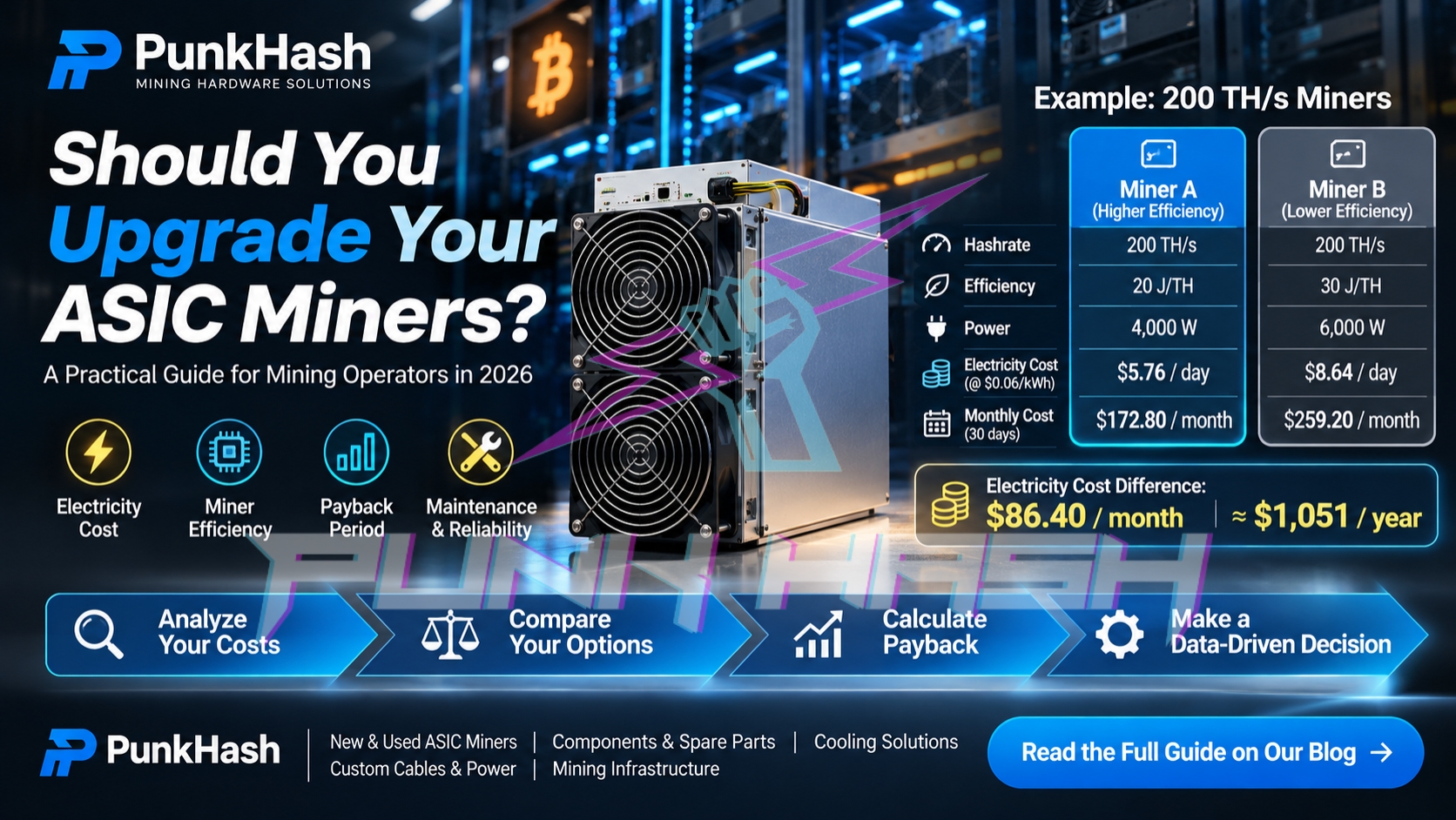
Should You Upgrade Your ASIC Miners or Keep Running Them in 2026?
A practical guide to evaluating mining hardware efficiency, electricity costs, equipment condition, and upgrade decisions.
Bitcoin mining is becoming more competitive, but replacing older mining equipment is not always the best financial decision.
On October 29, 2026, Bitcoin’s mining difficulty increased by 5.54%, reaching 148.36 trillion. By November 2, the estimated Bitcoin hashprice was approximately $33.24 per PH/s per day.
These changes put additional pressure on mining operators, particularly those using older equipment or paying relatively high electricity rates.
However, lower mining revenue does not automatically mean every operator should purchase new hardware.
The right decision depends on electricity costs, equipment efficiency, acquisition prices, operating conditions, and the expected payback period.
In this guide, we’ll explain how to evaluate whether upgrading your ASIC miners makes financial sense.
1. Start With Electricity Costs, Not Machine Prices
One of the most common mistakes in ASIC mining equipment procurement is comparing machines based only on their purchase prices.
A lower-priced miner may consume significantly more electricity than a newer model.
Consider two hypothetical ASIC miners:
| Технические характеристики | Miner A | Miner B |
|---|---|---|
| Хешрейт | 200 TH/s | 200 TH/s |
| Эффективность | 20 J/TH | 30 J/TH |
| Power consumption | 4,000W | 6,000W |
| Electricity rate | $0.06/kWh | $0.06/kWh |
| Daily electricity cost | $5.76 | $8.64 |
| Monthly electricity cost (30 days) | $172.80 | $259.20 |
Although both machines deliver the same hashrate, Miner B consumes an additional 2kW.
This creates an electricity cost difference of $86.40 over 30 days, or approximately $1,051.20 over 365 days, assuming continuous operation.
The important lesson: lower hardware costs can be offset by higher operating expenses.
2. Calculate Your Electricity-Only Break-Even Point
Before deciding whether to upgrade, estimate how much revenue your equipment generates and compare it with its electricity consumption.
A simplified daily revenue calculation is:
Daily gross mining revenue = Hashrate (PH/s) × Hashprice ($/PH/s/day)
Daily electricity cost can be calculated as:
Power consumption (kW) × 24 × Electricity rate ($/kWh)
For example, assume:
- Hashrate: 200 TH/s, equivalent to 0.2 PH/s
- Hashprice: $33.24 per PH/s per day
- Power consumption: 4kW
- Electricity rate: $0.06/kWh
Estimated daily gross revenue:
0.2 × $33.24 = $6.65
Daily electricity cost:
4 × 24 × $0.06 = $5.76
Estimated daily amount remaining after electricity:
$6.65 − $5.76 = $0.89
This is not net profit.
Pool fees, cooling, maintenance, downtime, hosting expenses, and equipment depreciation have not been deducted.
The calculation simply shows how much revenue remains after direct electricity costs under the stated assumptions.
The hashprice is a changing market indicator, not a guaranteed payout.
3. When Does Upgrading an ASIC Miner Make Sense?
An upgrade may be worth considering when the existing equipment has become too expensive to operate relative to the revenue it generates.
Typical situations include:
High Electricity Costs
Operators paying higher electricity rates are generally more sensitive to equipment efficiency.
Even a relatively small improvement in J/TH can create meaningful operating cost savings across hundreds of machines.
Frequent Equipment Failures
Older equipment may require additional repairs, replacement fans, power supplies, or hashboards.
These expenses should be included in the upgrade comparison.
Limited Electrical Capacity
If a mining farm has a fixed power limit, higher-efficiency equipment may allow more hashrate to operate within the same electrical capacity.
Significant Efficiency Improvements
A newer machine may deliver a lower cost per TH/s over its remaining operating life.
However, the purchase price and deployment costs must still be considered.
4. When Might Keeping Your Existing Miners Be Better?
Replacing equipment is not always necessary.
Continuing to operate existing ASIC miners may make sense when:
- Electricity prices are particularly low.
- Existing machines are stable and require little maintenance.
- The purchase price of replacement equipment is relatively high.
- The remaining operating period is short.
- Upgrading would create substantial shipping, installation, or downtime costs.
For example, an operator paying $0.03/kWh may reach a different decision from one paying $0.08/kWh, even when using identical equipment.
This is why mining hardware recommendations should begin with the customer’s operating conditions.
5. Calculate the Upgrade Payback Period
A useful next step is to estimate how long it would take for operating improvements to recover the upgrade investment.
A simplified calculation is:
Upgrade payback period = Net upgrade cost ÷ Additional daily operating contribution
Net upgrade cost includes:
- Purchase price of replacement miners
- Shipping and import expenses
- Installation and electrical modifications
- Expected downtime during replacement
- Less any proceeds from selling the old equipment
Additional daily operating contribution should account for both changes in mining revenue and changes in operating costs.
For an illustrative example:
- Net upgrade cost: $1,200
- Additional daily operating contribution: $2.00
Estimated simple payback period:
$1,200 ÷ $2.00 = 600 days
This does not guarantee that the upgrade will recover its cost in 600 days.
Bitcoin price, mining difficulty, network fees, equipment reliability, and other factors can change.
It is better to compare several scenarios rather than rely on a single forecast.
6. New ASIC Miners vs Used ASIC Miners
New equipment may offer better efficiency and manufacturer support, while used equipment can provide a lower acquisition cost.
Neither option is automatically better.
When comparing new and used ASIC miners, evaluate:
| Factor | What to Check |
|---|---|
| Purchase price | Total acquisition cost |
| Эффективность | Measured J/TH |
| Equipment condition | Operating history and inspection |
| Testing | Actual hashrate and wall power |
| Гарантия | Manufacturer or seller coverage |
| Доставка | Delivery costs and import requirements |
| Downtime | Expected installation and maintenance |
| Payback | Sensitivity to electricity and hashprice |
For used ASIC equipment, request recent testing records whenever possible.
These may include:
- Hashrate screenshots
- Hashboard status
- Operating temperatures
- Actual power consumption
- Serial number records
- Running videos
- Agreed DOA terms
A low price without reliable equipment information may introduce additional risks.
7. Don’t Ignore Cooling and Infrastructure Costs
ASIC miner efficiency is not the only consideration.
Cooling systems, power distribution, cabling, and electrical capacity can influence the total cost of operating a mining farm.
For larger projects, operators may need to compare:
Воздушное охлаждение
Typically simpler to deploy but dependent on airflow, ambient conditions, filtration, and fan performance.
Гидроохлаждение
Can support different thermal management requirements, but may involve additional cooling infrastructure, pumps, heat exchangers, plumbing, and maintenance.
Before choosing an upgrade, evaluate the complete mining system rather than only the miner specification.
8. A Practical ASIC Miner Upgrade Checklist
Before making a purchasing decision, answer these questions:
- What is your actual electricity rate?
- What are the hashrate and measured power consumption of your existing miners?
- How much maintenance do your current machines require?
- What is the complete landed cost of replacement equipment?
- Can your electrical and cooling infrastructure support the new machines?
- How much downtime would the upgrade require?
- What is the estimated payback period under different market conditions?
- What happens if hashprice declines further?
- Are testing records and warranty terms available?
- Does the upgrade support your long-term operating plan?
A good supplier should help you work through these questions instead of simply recommending the most expensive machine.
9. How PunkHash Supports Mining Equipment Decisions
At PunkHash, we work with new and used ASIC mining equipment, components, and mining infrastructure solutions.
Our objective is to help customers evaluate equipment options based on their actual operating requirements.
Depending on the project, this may include:
- New and used ASIC miner sourcing
- Equipment specification comparisons
- Testing and inspection coordination
- Mining components and replacement parts
- Custom power cables and connectors
- Air-cooling and hydro-cooling infrastructure
- Shipping and procurement coordination
Equipment availability, testing arrangements, and after-sales terms depend on the specific batch and transaction.
For customers considering a fleet upgrade, we recommend sharing:
Existing miner model + quantity + electricity rate + location + target budget
This information provides a more useful starting point than requesting a machine price alone.
10. Frequently Asked Questions
Is it worth upgrading ASIC miners in 2026?
It depends on your electricity rate, existing equipment efficiency, upgrade cost, maintenance requirements, and expected operating period. A more efficient machine is not automatically the best financial choice.
Is buying used ASIC miners still worthwhile?
Used ASIC miners may be suitable for operators with favorable electricity rates and carefully evaluated equipment. Testing, condition, total cost, and after-sales terms should be checked before purchase.
What does J/TH mean?
J/TH stands for joules per terahash. It measures energy efficiency. Lower J/TH generally means less electricity is required to perform the same amount of hashing work.
How do I calculate ASIC miner electricity costs?
Multiply the machine’s power consumption in kilowatts by 24 hours and your electricity rate per kWh. For example, a 4kW machine at $0.06/kWh costs $5.76 per day in electricity if operated continuously.
Does a lower electricity cost guarantee mining profitability?
No. Electricity is only one operating expense. Profitability also depends on mining revenue, equipment costs, downtime, maintenance, pool fees, and other expenses.
Conclusion: Upgrade Based on Your Numbers, Not Market Hype
Mining equipment decisions should not be driven by headlines or the latest hardware launch alone.
For some operators, upgrading to higher-efficiency ASIC miners may improve operating economics.
For others, continuing to run existing equipment may be more practical.
The best decision is the one supported by real operating data, realistic cost assumptions, and a clear understanding of risk.
Need Help Comparing ASIC Mining Equipment?
PunkHash can discuss available mining hardware options and related infrastructure requirements.
Веб-сайт: https://www.punkhash.com/
Explore Mining Equipment: https://www.punkhash.com/shop/
WhatsApp: https://wa.me/85293158482
Send us your current miner model, quantity, electricity rate, and destination to discuss suitable equipment options.
PunkHash — Mining Hardware and Infrastructure Solutions.