
Bitcoin Mining vs. AI Compute:Why Power and Cooling Are Becoming the New Bottlenecks

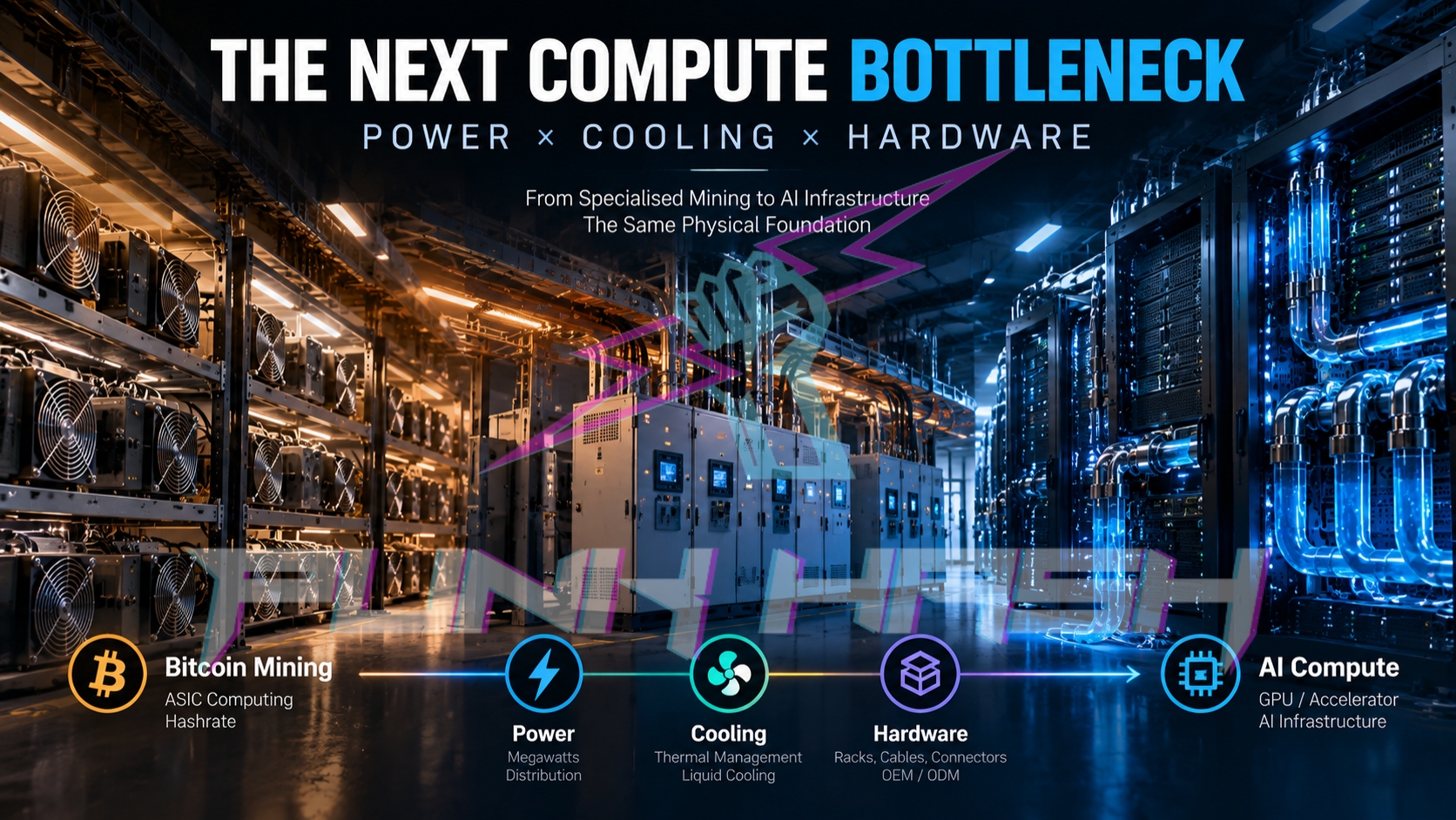
Bitcoin Mining vs. AI Compute: Why Power and Cooling Are Becoming the New Bottlenecks
October 16, 2026 | PunkHash Industry Insights
For years, Bitcoin mining has been one of the clearest examples of a computing business where electricity, hardware efficiency and infrastructure determine economics.
Today, AI computing is facing a similar challenge — but at a much larger scale.
The competition is no longer only about who has the fastest chip.
It is increasingly about:
Who has access to power?
Who can distribute that power efficiently?
Who can remove the heat?
And who can build the hardware infrastructure fast enough?
Recent developments across Bitcoin mining and AI data centers suggest that power and cooling are becoming strategic resources for the entire computing industry.
Bitcoin Mining Has Always Been a Power Business
A Bitcoin ASIC converts electricity into hashing power.
The economic equation is relatively simple:
Electricity → Hashrate → Bitcoin Revenue
But the margin depends on several variables:
- Bitcoin price
- Network difficulty
- Transaction fees
- ASIC efficiency
- Electricity cost
- Cooling infrastructure
- Hardware acquisition cost
- Uptime
As of October 16, 2026, Luxor’s Bitcoin Hashprice Index shows a spot hashprice of approximately $39.58 per PH/s per day, while the seven-day network hashrate is around 1,012 EH/s. The network was also approaching another difficulty adjustment.
This illustrates an important point:
A more powerful machine does not automatically create a better mining investment.
The relationship between hardware efficiency, electricity cost, capital expenditure and network difficulty matters more than hashrate alone.
AI Compute Is Now Facing a Similar Constraint
AI infrastructure operates under a different economic model.
Instead of mining Bitcoin, AI data centers sell computing capacity for:
- Model training
- AI inference
- Large language models
- Agentic AI
- Enterprise applications
- Cloud computing
- High-performance computing
But the physical infrastructure has a familiar problem.
AI accelerators consume electricity and generate heat.
As computing density increases, traditional data center infrastructure becomes increasingly difficult to scale.
At the 2026 OCP Global Summit, NVIDIA introduced additional open architecture contributions for its Vera Rubin platform.
The NVIDIA MGX 1.2 architecture includes rack-scale liquid cooling, interoperable infrastructure, a liquid-cooled 5,000A busbar, and support for rack deployments up to 250kW.
This is a significant signal.
The industry is increasingly designing:
Compute + Power + Cooling
as one integrated system.
The Competition Is Moving From Chips to Megawatts
One of the most interesting developments in 2026 is that different types of computing are increasingly competing for the same physical resource:
electricity.
Recent research from Hashrate Index compared Zcash ASICs, Bitcoin ASICs and NVIDIA H100 GPU compute on a common energy basis.
Under its October 13 assumptions, the study estimated approximately:
- Z15 Pro: $773/MWh
- Efficient Bitcoin ASIC fleet: approximately $135/MWh
- H100 at full utilization: approximately $1,679/MWh
These are modelled revenue figures, not guaranteed profits, and the comparison changes significantly depending on hardware cost, utilization, electricity price and market conditions.
The important lesson is not which machine wins.
The important lesson is:
The same megawatt can now be allocated to different forms of computing.
Bitcoin mining.
AI computing.
Zcash mining.
Cloud computing.
High-performance computing.
This creates a new infrastructure-level competition.
Why Cooling Is Becoming Just as Important as Power
Power is only half of the problem.
The other half is heat.
Bitcoin mining has already developed several cooling approaches:
- Air cooling
- Hydro cooling
- Immersion cooling
- Containerized cooling infrastructure
AI infrastructure is moving rapidly toward higher-density liquid cooling as accelerator power increases.
At OCP 2026, Delta highlighted an NVIDIA-compatible 800VDC power architecture, including a 660kW in-row power rack and a liquid-to-liquid CDU with up to 2.5MW cooling capacity.
This illustrates how data center infrastructure is evolving.
Power distribution and thermal management are no longer isolated components.
They are becoming part of the same rack-scale engineering system.
What Open Hardware Means for the Supply Chain
Another important development is the increasing adoption of open hardware architectures.
NVIDIA’s Vera Rubin architecture is being contributed to the OCP ecosystem, allowing system builders and infrastructure partners to work from common architectural foundations.
Open architecture does not mean that every manufacturer can immediately build an AI rack.
Qualified suppliers still need:
- Engineering capability
- Manufacturing quality
- Electrical validation
- Thermal validation
- Testing procedures
- Production consistency
- Supply chain reliability
But it can create more opportunities for specialized suppliers.
The future AI infrastructure supply chain will not consist only of GPU manufacturers.
It will also require companies producing and integrating:
- Power distribution components
- Cable assemblies
- Connectors
- Cooling components
- Mechanical structures
- Monitoring hardware
- PCB assemblies
- Rack accessories
- Custom hardware
This is where the broader hardware supply chain becomes interesting.
What Bitcoin Mining Can Teach AI Infrastructure
Bitcoin mining is often viewed only as a cryptocurrency industry.
But the industry has spent more than a decade solving practical problems around high-density computing.
Mining operators have experience with:
Power Optimization
Every watt matters when electricity represents one of the largest operating expenses.
Thermal Management
High-density ASICs require continuous heat removal.
Hardware Deployment
Thousands of machines need standardized installation, testing and maintenance.
Remote Monitoring
Large fleets require real-time monitoring of temperature, hashrate, power consumption and hardware status.
Hardware Lifecycle Management
Machines need procurement, deployment, maintenance, repair and eventual replacement.
These capabilities do not make mining hardware directly interchangeable with AI infrastructure.
However, they provide useful operational experience.
The Next Opportunity May Be the Infrastructure Around Computing
This is where we see an interesting opportunity for hardware suppliers.
Instead of asking:
“Which chip will win?”
A better question may be:
“What infrastructure will every computing system need regardless of which chip wins?”
Power.
Cooling.
Connectivity.
Monitoring.
Mechanical infrastructure.
Testing.
Maintenance.
Manufacturing.
These are recurring requirements across different computing markets.
Opportunities for Hardware OEM and ODM
For hardware manufacturers, this creates several potential areas of development.
1. Custom Power Cable Assemblies
Different computing systems require different cable lengths, connector combinations and electrical specifications.
Customized cable assemblies can support specific rack and equipment configurations.
2. Cooling Components
As liquid cooling becomes more common, there is increasing demand for compatible thermal-management components.
These must be engineered and validated for their intended applications.
3. Electronic Hardware
PCB and PCBA manufacturing can support specialized computing products, monitoring systems and control hardware.
4. Mechanical Components
Racks, brackets, enclosures and supporting structures remain essential components of high-density computing infrastructure.
5. Small-Batch AI Hardware
Emerging AI hardware companies may require engineering samples, prototypes and pilot production before committing to large-scale manufacturing.
This creates opportunities for flexible OEM/ODM partners.
Where PunkHash Fits
PunkHash’s experience began with cryptocurrency mining hardware and the ASIC supply chain.
Our work includes:
ASIC 채굴 하드웨어
Supporting customers with new and used mining hardware sourcing.
광업 인프라
Helping customers evaluate equipment, power requirements, cooling conditions and deployment considerations.
Custom Hardware
Through PunkForge, exploring OEM/ODM opportunities for customized hardware and components.
AI Compute
Expanding our understanding of AI infrastructure, hardware manufacturing and computing supply chains.
We are not positioning Bitcoin mining and AI computing as the same industry.
They are not.
Instead, we see them as two different applications connected by an increasingly important physical layer:
Power + Cooling + Hardware + Infrastructure.
What Buyers Should Evaluate in 2026
Whether you are purchasing Bitcoin ASICs or planning an AI computing deployment, several questions should be answered before purchasing hardware.
| Area | Key Question |
|---|---|
| Electricity | What is the actual delivered power cost? |
| Capacity | Is sufficient power available? |
| Cooling | Can the facility remove the expected heat load? |
| Hardware | What is the real efficiency under operating conditions? |
| Infrastructure | Are cables, connectors and power systems compatible? |
| Reliability | What testing and quality assurance are available? |
| Maintenance | How will failures be handled? |
| CAPEX | What is the total infrastructure investment? |
| OPEX | What are the actual operating costs? |
| Supply Chain | Can the supplier support the project after delivery? |
The cheapest machine is not necessarily the cheapest computing solution.
The most powerful chip is not necessarily the best investment.
And the largest data center is not necessarily the most efficient one.
The economics of computing are increasingly determined at the infrastructure level.
The Bigger Picture
Bitcoin mining taught the computing industry an important lesson:
Computing performance has little value without affordable electricity and reliable infrastructure.
AI is now pushing this principle to another level.
As AI racks move toward higher power density, the industry will increasingly need better power distribution, liquid cooling, modular architectures and specialized hardware manufacturing.
At the same time, Bitcoin mining continues to evolve toward more efficient ASICs, advanced cooling and better utilization of low-cost power.
The two industries will remain different.
But they are increasingly connected by the same physical constraints.
The next computing bottleneck may not be the chip.
It may be the megawatt behind it.
Looking for Mining Hardware or Custom Hardware Manufacturing?
PunkHash works across the ASIC mining hardware supply chain and explores custom OEM/ODM opportunities through PunkForge.
If you are sourcing mining hardware, developing computing hardware, or looking for a manufacturing partner for custom power, electronic or mechanical components, contact our team with your specifications, estimated quantity and project requirements.
PunkHash — Mining Hardware · AI Compute · Hardware Manufacturing
Disclaimer: Market data and third-party performance figures referenced in this article are provided for informational purposes only. Actual mining and computing economics depend on electricity prices, hardware performance, utilization, market conditions, infrastructure costs and other factors. Technical specifications must be independently validated for each application.