
From AI Development Boards to Industrial Edge AI Products: A Practical OEM/ODM Guide

From AI Development Boards to Industrial Edge AI Products: A Practical OEM/ODM Guide
How AI hardware companies can move from prototype development to reliable industrial deployment.
Introduction: Edge AI Is Moving Beyond Prototypes
Edge AI is becoming an important part of robotics, industrial automation, machine vision, and intelligent devices.
Instead of sending every task to the cloud, edge AI systems can process selected data locally, helping reduce latency, support offline operation, and improve control over sensitive information.
However, there is a significant difference between building a working AI prototype and manufacturing a reliable industrial product.
An AI development board may be suitable for early testing, but commercial deployment requires careful consideration of hardware integration, thermal management, software compatibility, and long-term component availability.
For AI hardware companies and industrial OEMs, these challenges create opportunities for specialized component suppliers and manufacturing partners.
This article explains what companies should consider when turning an AI development board into a production-ready edge AI device.
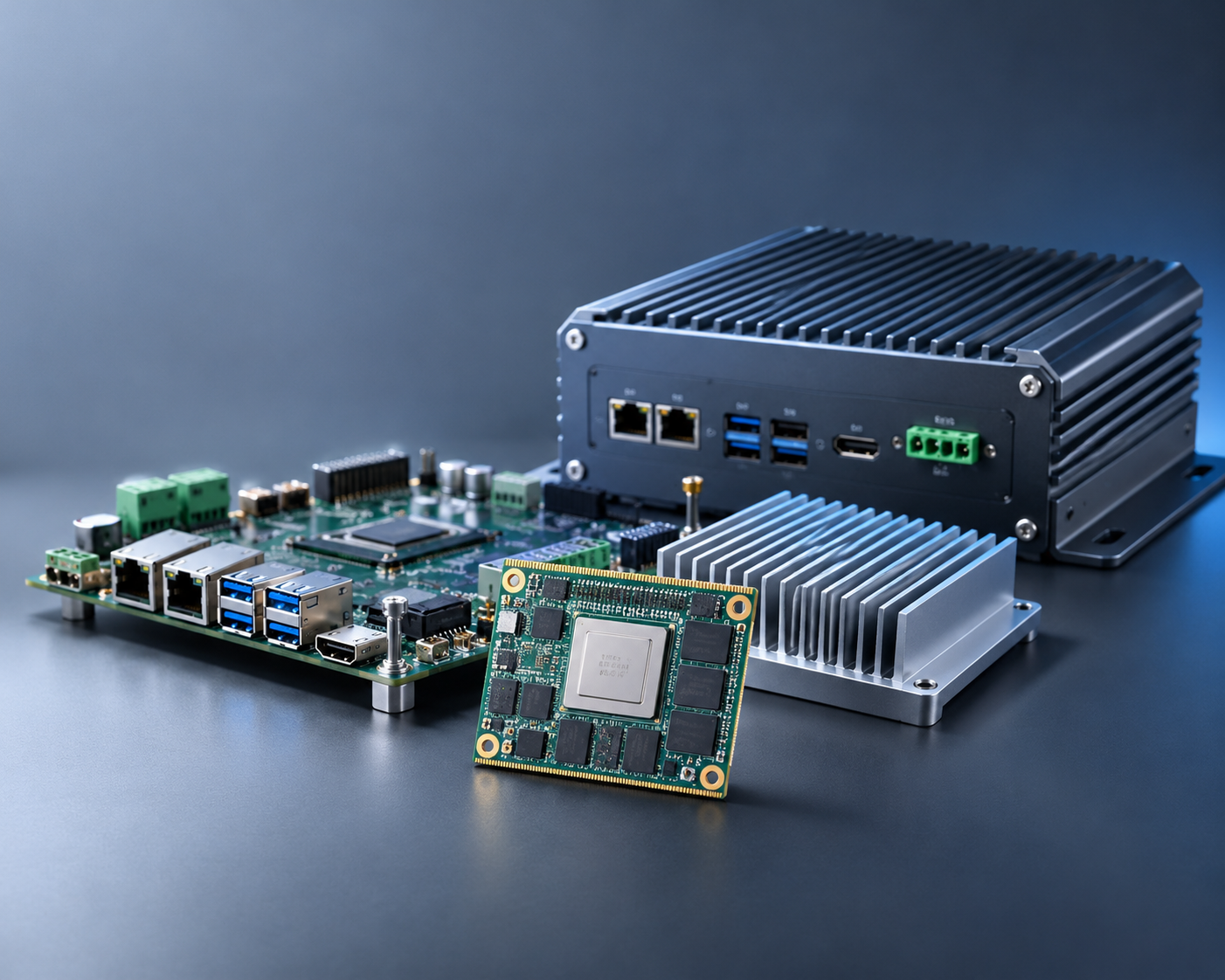
1. AI Development Board vs. Industrial AI Module vs. Edge AI Box
Before choosing a hardware platform, it is important to understand three common product categories.
AI Development Board
A development board provides a convenient environment for software testing, AI model validation, and prototype development.
Common examples include development platforms built around NVIDIA Jetson, Rockchip RK3588, and other embedded AI processors.
Development boards are useful for evaluating performance, software tools, and peripheral compatibility.
However, they may not meet the mechanical, environmental, or lifecycle requirements of a finished industrial product.
System-on-Module (SoM)
A System-on-Module integrates key computing components, typically including a processor, memory, and essential supporting circuitry.
It can be connected to a carrier board designed for a specific application.
This approach allows OEMs to customize interfaces, power distribution, and mechanical integration while using an established computing module.
Industrial Edge AI Box
An industrial AI box combines computing hardware with an enclosure, power system, cooling solution, and application-specific interfaces.
Depending on its design, it may be used for machine vision, factory automation, robotics, smart retail, or industrial monitoring.
The correct choice depends on the application, software requirements, production volume, and operating environment.
2. Choosing the Right Edge AI Computing Platform
Several hardware ecosystems are relevant to modern edge AI development.
NVIDIA Jetson
Jetson platforms are widely considered for robotics, computer vision, and GPU-accelerated AI workloads.
Key evaluation factors include supported AI frameworks, JetPack compatibility, power requirements, module availability, and thermal design.
Rockchip RK3588
RK3588-based platforms are used in embedded computing, multimedia processing, and certain edge AI applications.
OEMs should evaluate NPU software support, Linux or Android compatibility, camera interfaces, and the availability of suitable carrier boards.
Qualcomm Dragonwing
Qualcomm’s embedded computing platforms address applications such as robotics, intelligent cameras, and industrial devices.
Platform selection should consider supported software, AI acceleration, connectivity, development resources, and production availability.
Hailo AI Accelerators
Hailo accelerators are designed to support selected edge AI inference workloads.
For example, Raspberry Pi AI HAT+ 2 integrates a Hailo-10H accelerator and 8GB of dedicated memory for supported local vision and generative AI applications.
However, advertised TOPS figures should not be compared without considering numerical precision, model compatibility, memory, and real application performance.
Intel Industrial Computing Modules
Industrial modules based on Intel processors provide another option for embedded computing and machine vision.
On November 3, 2026, Tria Technologies introduced the C6C-PLH, a 95 × 95 mm COM Express Compact Type 6 module based on Intel Core Ultra Series 3 processors.
The module combines CPU, GPU, and NPU capabilities and targets applications such as industrial automation, robotics, and machine vision.
Its emphasis on industrial options, standard interfaces, and long-term availability illustrates an important direction in embedded computing.
3. Why Power Design Matters
Power design is one of the first engineering challenges when moving from a prototype to a commercial product.
An industrial AI device may need to operate continuously in environments with varying electrical conditions.
Important considerations include:
- Input voltage and power budget
- Peak and sustained computing loads
- Connector ratings and pin assignments
- Power protection
- Cable routing and mechanical strain relief
- Industrial power supply compatibility
- Electrical safety and applicable certification requirements
Custom power cables and wiring harnesses can help meet specific installation requirements.
However, every custom electrical assembly must be verified for its intended voltage, current, grounding, and environmental conditions.
4. Thermal Management for Edge AI Devices
AI processors generate heat, and thermal management becomes particularly important when systems operate continuously or inside compact enclosures.
Depending on the hardware platform and environment, possible solutions include:
- Passive heatsinks
- Heat pipes
- Active fans
- Thermal interface materials
- Custom metal enclosures
- Liquid cooling for suitable high-power applications
A fanless industrial AI box may require a completely different thermal design from a high-performance robotics computing platform.
OEMs should evaluate processor power consumption, enclosure geometry, ambient temperature, airflow, and sustained workload performance.
Thermal validation should be performed under representative operating conditions rather than relying only on processor specifications.
5. Custom Carrier Boards and Industrial Connectivity
A standard development board may include interfaces that are unnecessary for a finished product while lacking others required by the customer.
A custom carrier board can help adapt a computing module to a specific application.
Depending on the platform, common requirements may include:
- Ethernet and industrial networking
- USB interfaces
- Camera connectivity
- CAN or serial communication
- GPIO and control interfaces
- Storage expansion
- Power input and monitoring
- Application-specific connectors
For robotics and industrial automation, reliable communication between computing, sensing, and control systems is particularly important.
The final interface design must be validated against the computing module’s electrical specifications and software support.
6. Software Compatibility and Long-Term Support
Hardware performance alone does not determine whether an edge AI project will succeed.
Software support is often a major factor in the transition from prototype to production.
Before choosing a platform, buyers should verify:
- Supported operating systems
- BSP and driver availability
- AI framework compatibility
- Model conversion and deployment tools
- Firmware update mechanisms
- Security maintenance
- Product lifecycle and long-term availability
A lower-cost computing board may become more expensive overall if software integration requires substantial additional engineering work.
For industrial OEM projects, total development and maintenance cost should be evaluated alongside hardware price.
7. OEM/ODM Manufacturing: From Prototype to Production
Once the computing platform has been selected, the next challenge is preparing the product for consistent manufacturing.
Depending on the project, an OEM/ODM manufacturing partner may support:
- Hardware component sourcing
- Custom carrier board development
- Mechanical enclosure design
- Cooling component manufacturing
- Cable and connector customization
- Prototype assembly
- Functional testing
- Manufacturing coordination
- Quality documentation
Not every supplier provides all these services, so capabilities, responsibilities, testing arrangements, and certifications should be confirmed before placing an order.
Edge AI OEM/ODM RFQ Checklist
When requesting a quotation, buyers should ideally provide:
| Requirement | Information to Provide |
|---|---|
| Solicitud | Robotics, machine vision, industrial monitoring, etc. |
| Computing platform | Preferred SoC, SoM, or development board |
| AI workload | Model type, performance and latency targets |
| Operating system | Linux, Android, Windows IoT, or other |
| Connectivity | Ethernet, USB, CAN, camera, serial interfaces |
| Potencia | Input voltage and power budget |
| Thermal conditions | Ambient temperature and enclosure limits |
| Mechanical requirements | Dimensions, mounting, enclosure material |
| Quantity | Prototype volume and estimated annual demand |
| Project timeline | Sample, validation, and mass production targets |
Clear specifications help suppliers evaluate technical feasibility, manufacturing requirements, and quotation accuracy.
8. How PunkHash Is Exploring Edge AI Hardware Opportunities
PunkHash has experience in ASIC mining hardware sourcing, cooling systems, custom components, and hardware supply chain coordination.
As computing applications expand beyond traditional cryptocurrency mining, we are exploring opportunities to support AI hardware companies, robotics developers, and industrial OEMs.
Our relevant areas of experience include:
Hardware sourcing and customization: Supporting project-specific component procurement and manufacturing coordination.
Cooling components: Experience with thermal management solutions and related hardware.
Custom electrical components: Power cables, connectors, and wiring assemblies for suitable applications.
OEM/ODM collaboration: Exploring customized hardware requirements with manufacturing and engineering partners.
Edge AI development boards, computing modules, and complete industrial AI boxes are areas under evaluation. Specific products, compatibility, supply availability, and customization capabilities must be confirmed for each project.
Our objective is to understand customer requirements first and develop practical hardware supply and customization solutions around real applications.
Preguntas frecuentes
What is the difference between an AI development board and an industrial AI computer?
An AI development board is generally designed for evaluation and prototyping. An industrial AI computer is designed as a more complete system, with attention to enclosure, power, cooling, connectivity, and deployment conditions.
Is an SoM better than a development board for OEM manufacturing?
An SoM can be useful for production designs that require custom interfaces and mechanical integration, but the best choice depends on engineering resources, production volume, cost, and software support.
Can an edge AI device operate without the cloud?
Some workloads can run locally, depending on the processor, accelerator, memory, model, and software configuration. Other applications may still require cloud connectivity.
What should buyers check before ordering custom edge AI hardware?
Buyers should confirm computing performance, software compatibility, power requirements, thermal conditions, interfaces, certification needs, production quantity, and delivery expectations.
Can mining hardware supply chain experience support edge AI projects?
Experience in component sourcing, cooling, power connections, and manufacturing coordination may be relevant. However, edge AI systems have their own computing, software, and reliability requirements and need separate validation.
Conclusion: Building Edge AI Products Requires More Than Computing Power
The edge AI market is creating opportunities for companies involved in embedded computing, robotics, industrial automation, and hardware manufacturing.
But moving from an AI development board to a commercial product requires more than selecting a powerful processor.
Reliable power, thermal management, custom interfaces, software support, component availability, and manufacturing quality all play essential roles.
For AI hardware companies and industrial OEMs, choosing the right hardware and manufacturing partners can help reduce development risks and support long-term product deployment.
At PunkHash, we believe the future of computing will be built through practical engineering, reliable hardware, and collaboration across the supply chain.
Discuss Your Edge AI Hardware Project
Are you developing a robotics platform, industrial AI device, or custom embedded computing product?
Share your application, preferred computing platform, technical requirements, estimated quantity, and project timeline.
We welcome discussions about hardware sourcing, cooling components, custom electrical assemblies, and potential OEM/ODM collaboration.
Página web: https://www.punkhash.com/
WhatsApp: https://wa.me/85293158482
PunkHash — Compute the Future Together.
References
Tria Technologies, November 3, 2026:
https://www.tria-technologies.com/2026/11/03/tria-c6c-plh-com-express-edge-ai/
Raspberry Pi AI HAT documentation:
https://www.raspberrypi.com/documentation/accessories/ai-hat-plus.html