
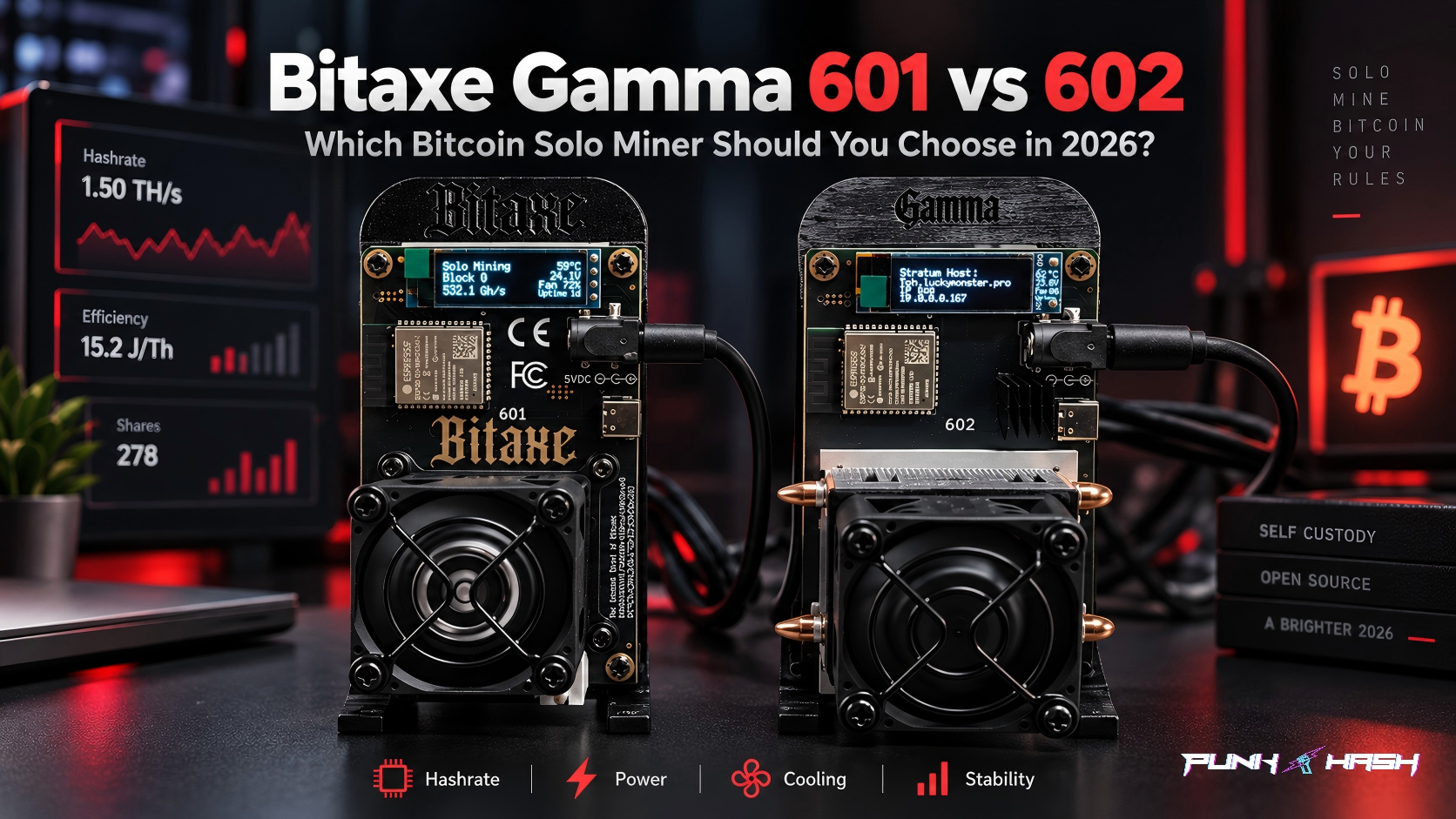
Bitaxe Gamma 601 vs 602: Which Bitcoin Solo Miner Should You Choose in 2026?

Home Bitcoin mining is changing.
Instead of running a full-size industrial ASIC drawing several kilowatts, more miners are experimenting with compact, low-power devices that can sit on a desk, connect to Wi-Fi and participate directly in Bitcoin mining.
Among them, the Bitaxe Gamma series has become one of the most recognized open-source Bitcoin mining platforms.
Two models frequently compared by home miners are the Bitaxe Gamma 601 and Bitaxe Gamma 602.
They share the same basic idea: compact SHA-256 mining powered by Bitmain’s BM1370 ASIC architecture. But when choosing between them, hashrate is not the only thing that matters.
Power consumption, cooling, stability and how aggressively you plan to tune the miner are equally important.
What Is the Bitaxe Gamma?
Bitaxe is an open-source Bitcoin ASIC mining platform designed around the idea that individuals should be able to participate in Bitcoin mining without operating an industrial mining farm.
The Gamma generation uses the BM1370 ASIC, the same ASIC generation used in the Antminer S21 Pro. The original Bitaxe Gamma project targets approximately 1.2 TH/s from a single BM1370 while focusing on low power, open-source firmware and easy home deployment.
Unlike a traditional industrial miner, a Bitaxe can:
- operate on a desk or shelf;
- connect over Wi-Fi;
- run without a separate computer;
- connect to compatible mining pools;
- be used for solo mining;
- allow frequency and voltage tuning;
- run open-source firmware such as AxeOS/ESP-Miner.
That makes Bitaxe especially interesting for hobbyists, developers and miners who want hands-on experience with ASIC hardware.
Bitaxe Gamma 601 vs 602: Quick Comparison
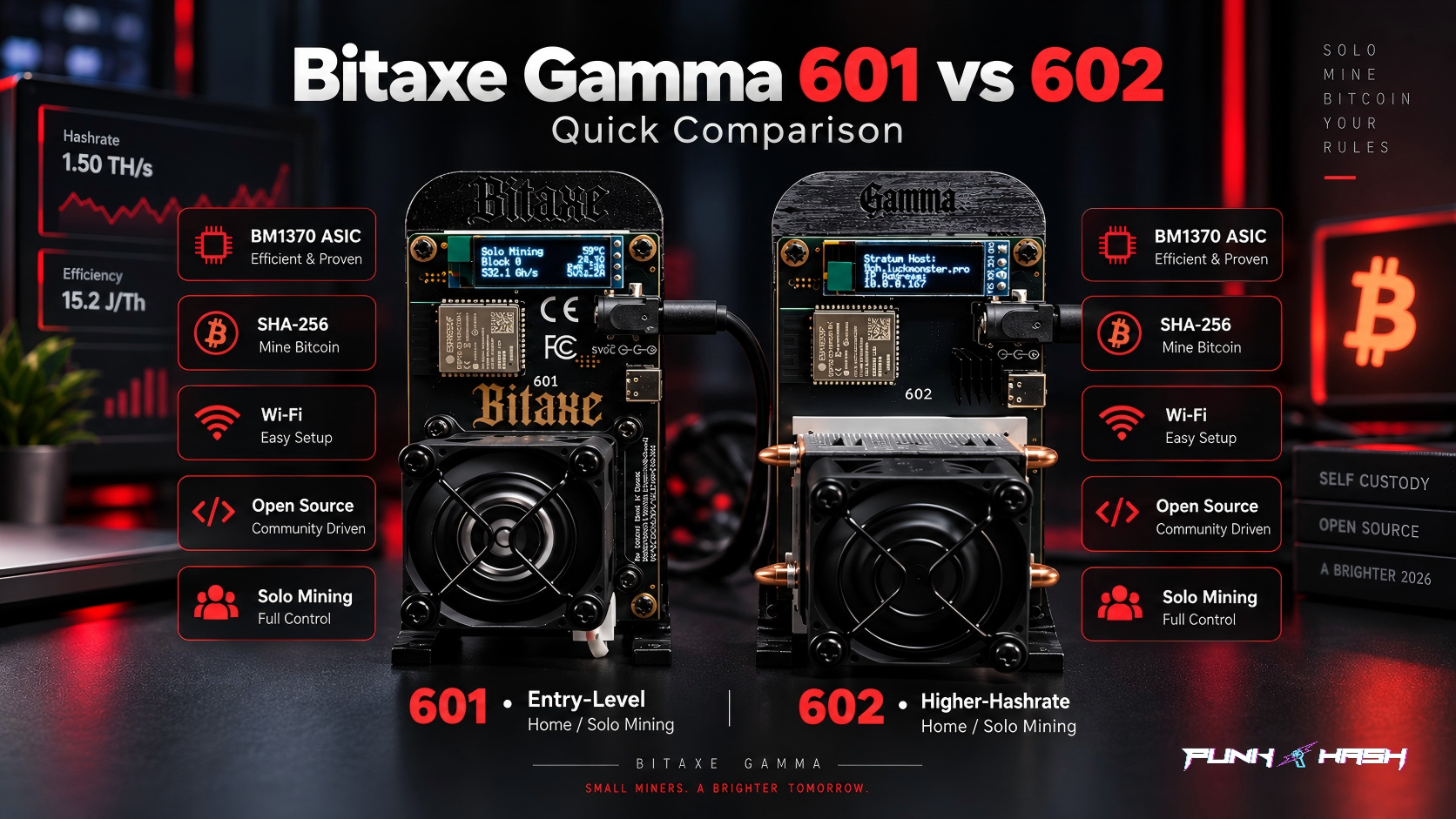
Typical performance varies depending on firmware, voltage, frequency, cooling and the specific build.
| Feature | Bitaxe Gamma 601 | Bitaxe Gamma 602 |
|---|---|---|
| ASIC | BM1370 | BM1370 |
| Algorithm | SHA-256 | SHA-256 |
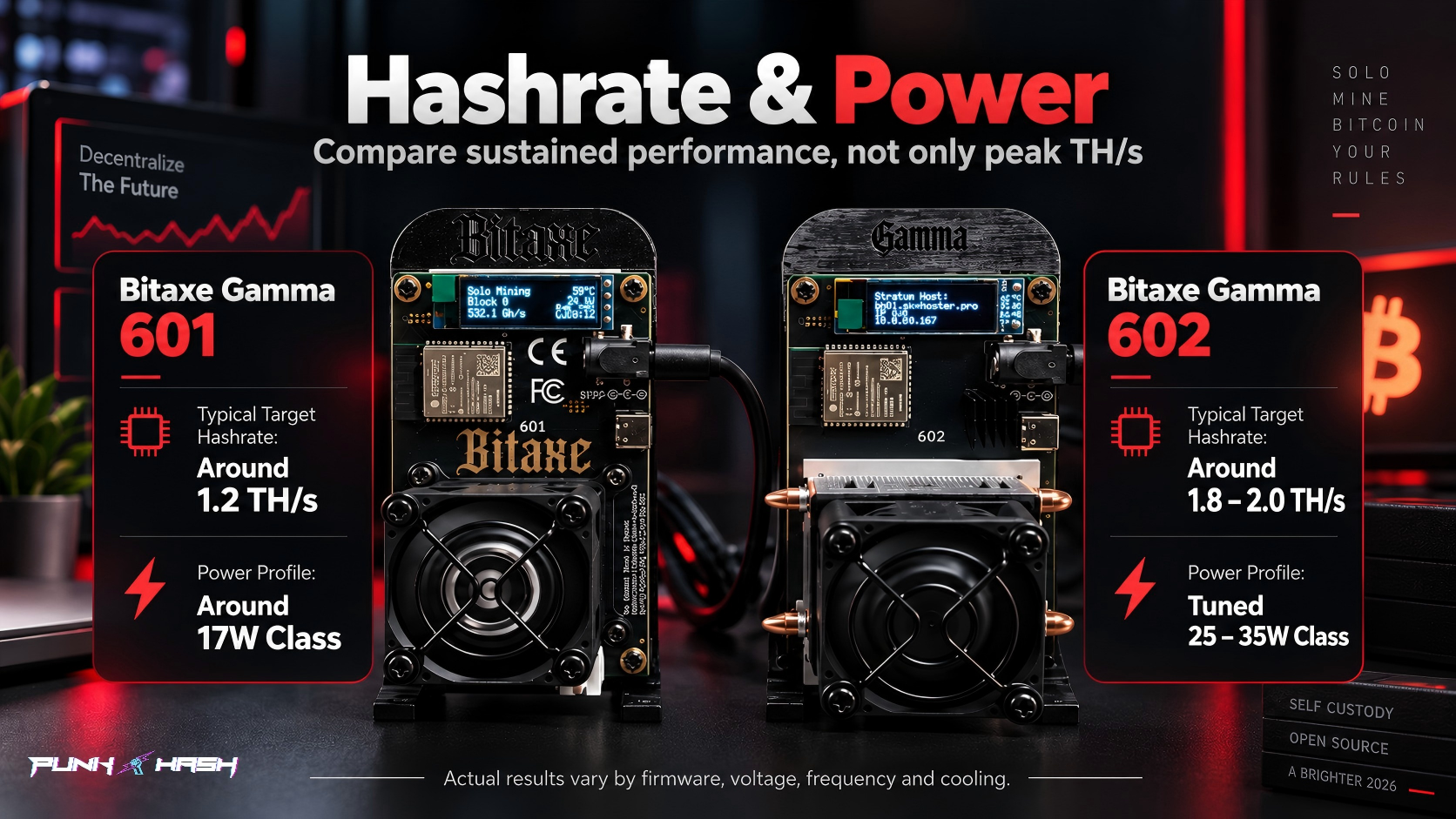
| Typical Target Hashrate | Around 1.2 TH/s | Around 1.8–2.0 TH/s when tuned |
| Power Profile | Around 17W class | Higher when tuned, often around 25–35W |
| Cooling Requirement | Relatively light | More important at higher tuning levels |
| Use Case | Entry-level home / solo mining | Higher-hashrate home / solo mining |
| Firmware | AxeOS / ESP-Miner ecosystem | AxeOS / ESP-Miner ecosystem |
Gamma 602 systems are commonly pushed toward the 1.8–2.0 TH/s range, but that level generally requires higher frequency, additional power and appropriate thermal management. Published community testing shows stock and tuned performance can vary considerably depending on cooling and voltage settings.
That is why comparing these miners only by the number printed beside “TH/s” can be misleading.
1. Hashrate: Is More Always Better?
For solo mining, every hash can be thought of as another attempt at finding a valid block.
A higher hashrate therefore gives the miner more attempts per second.
This makes the Gamma 602 attractive to users who want more hashrate from a single desktop device.
But solo mining is still probabilistic.
Going from roughly 1.2 TH/s to around 1.8–2.0 TH/s increases your hashrate, but it does not turn solo mining into predictable daily income.
For home miners, the more useful question is:
How much hashrate can the miner sustain reliably at the power, temperature and noise level you are comfortable with?
2. Power Consumption Matters at Home
Industrial miners are normally evaluated around electricity cost at scale.
Home miners have slightly different concerns.
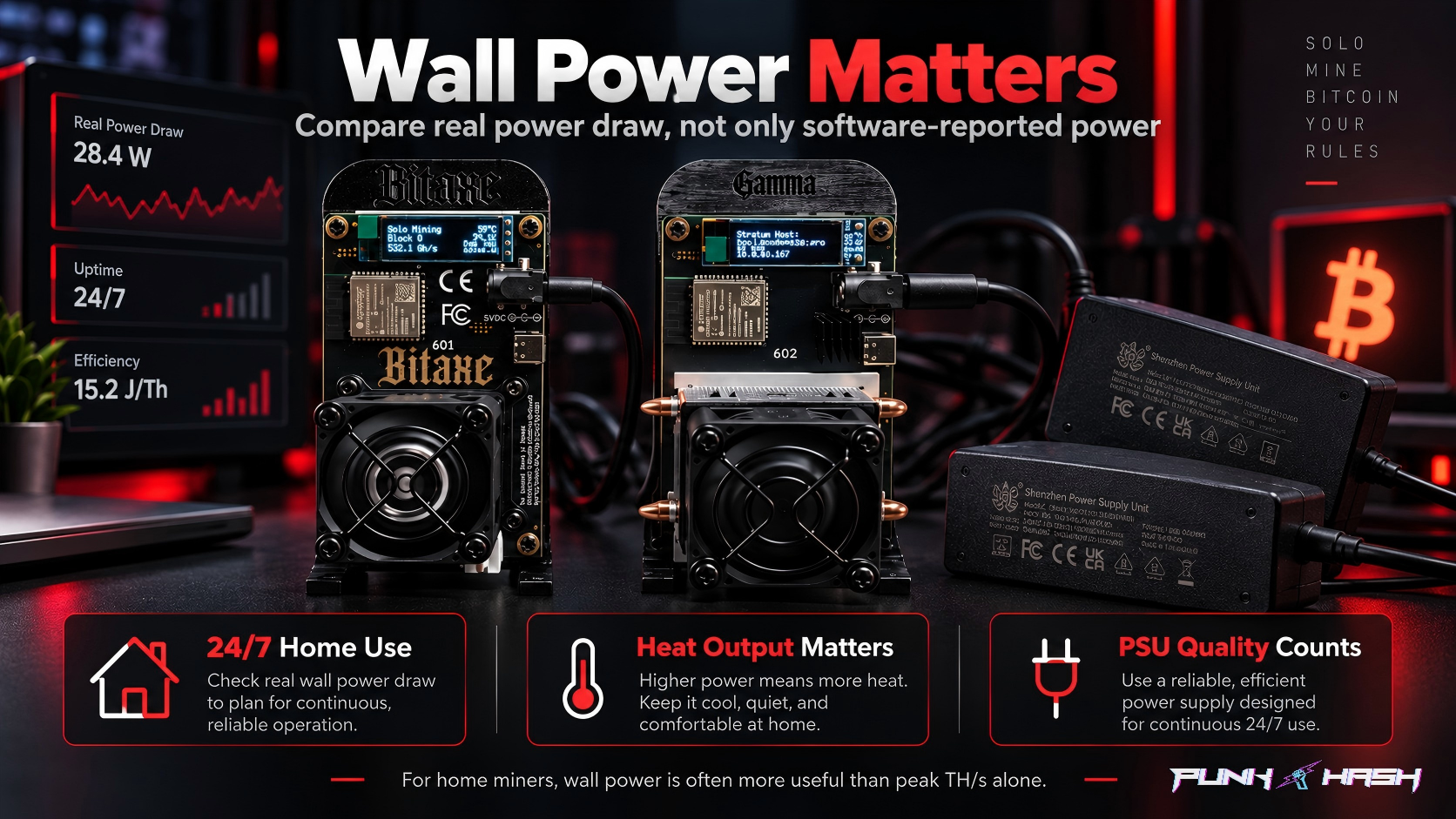
A desktop miner may run 24 hours a day in a bedroom, office or living space, so wall power, PSU quality and heat output all matter.
The Gamma 601 is attractive because it can deliver ASIC-level SHA-256 hashrate while staying in a very low-power category.
The Gamma 602 can provide more hashrate, but higher tuning levels also increase power consumption.
For example, independent Gamma 602 testing has shown configurations around 1.8 TH/s drawing roughly 30W-class power, while stock settings can be significantly lower.
For this reason, we recommend comparing wall power, not only software-reported power.
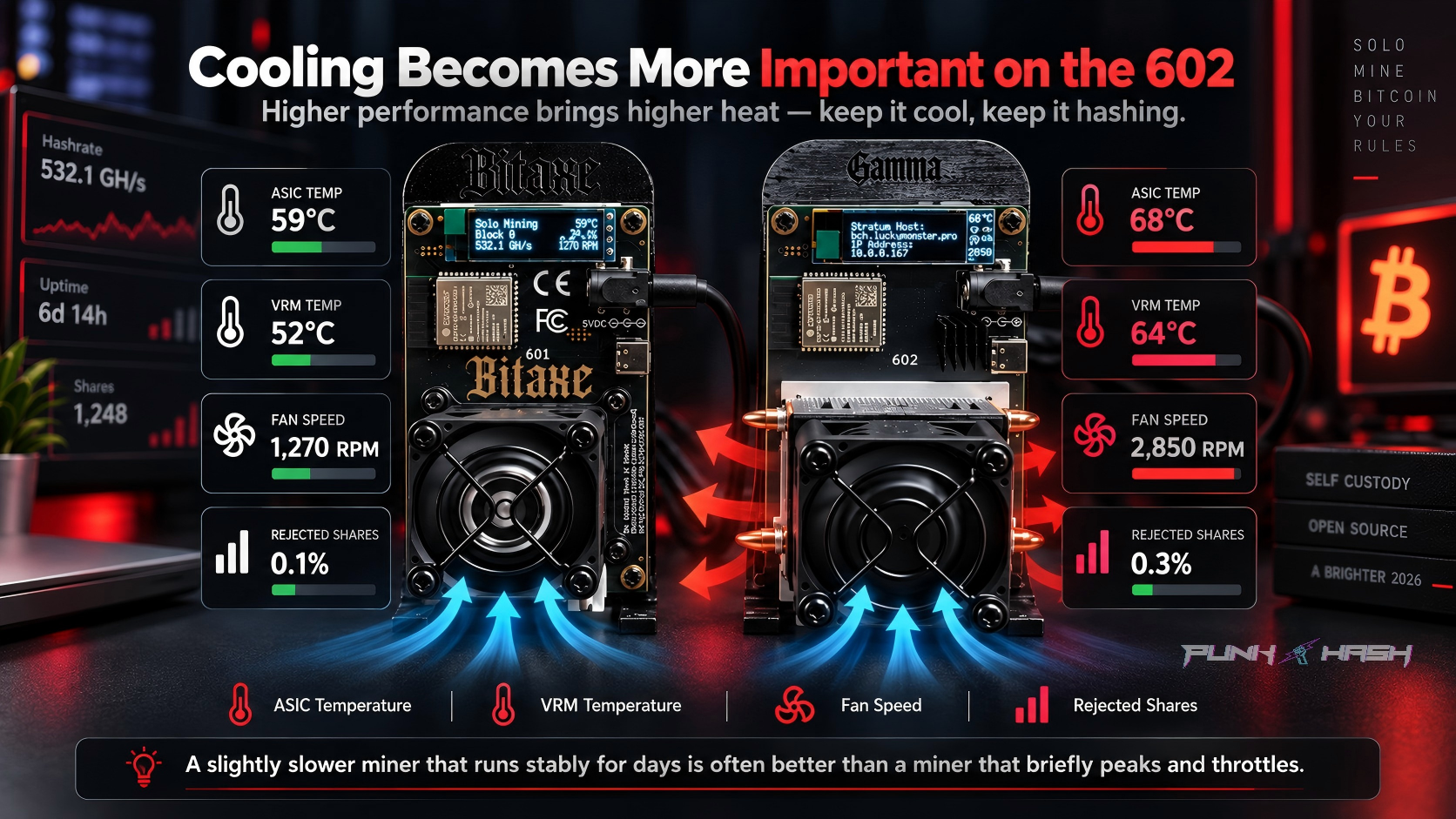
3. Cooling Becomes More Important on the 602
ASIC performance is closely connected to thermal management.
When frequency and voltage increase, the ASIC and voltage regulation components generate more heat.
The original Bitaxe Gamma documentation specifically warns that higher-performance configurations require active cooling and adequate power delivery.
For a standard home setup, users should monitor:
- ASIC temperature;
- voltage regulator temperature;
- fan speed;
- rejected shares;
- sustained hashrate;
- wall power.
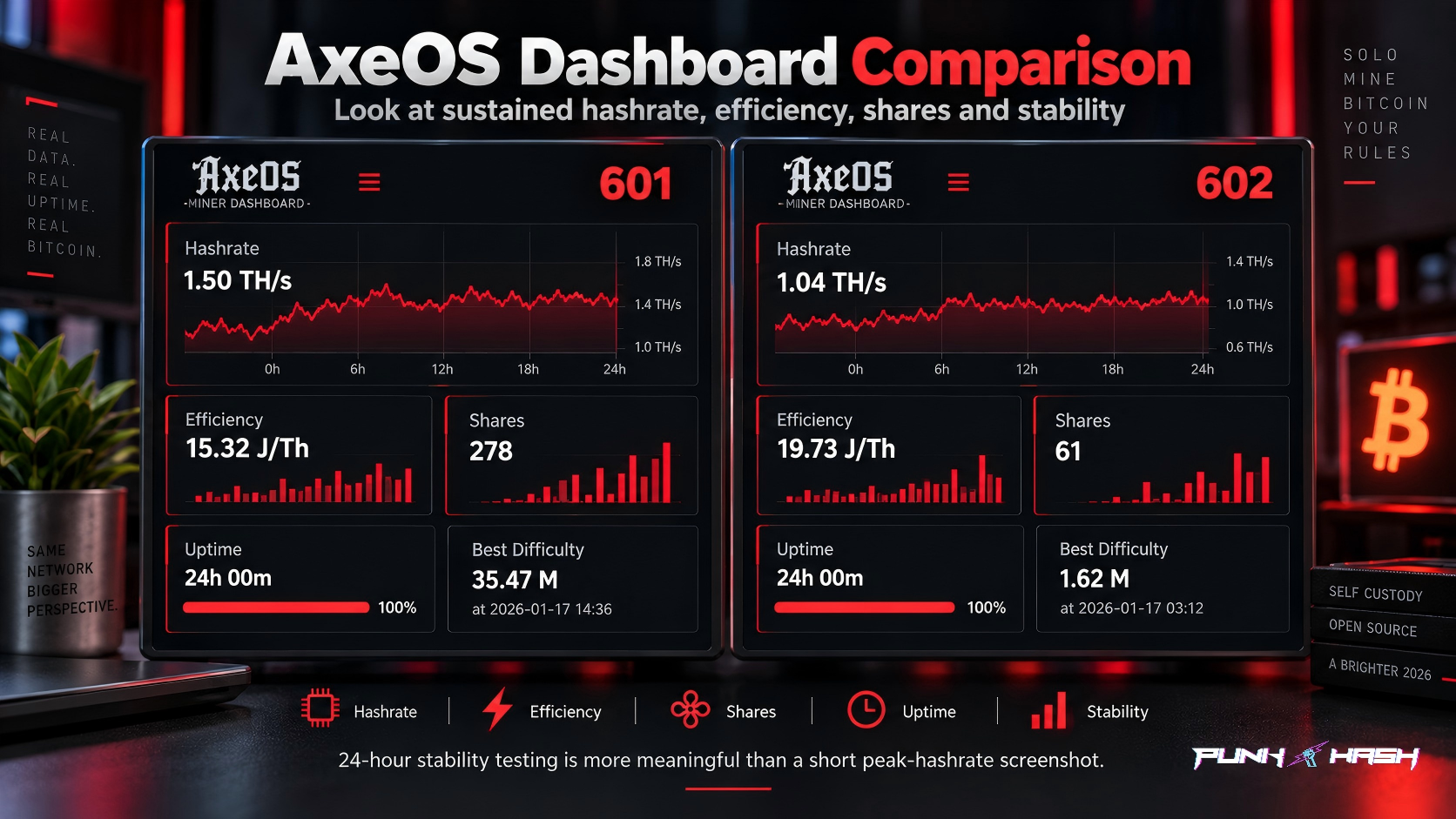
A miner that briefly reaches a high hashrate but throttles or produces errors after several hours is less useful than a slightly slower miner that runs consistently for days.
That is why 24-hour stability testing is more meaningful than a short peak-hashrate screenshot.
4. 601 May Be Better for Beginners
For someone entering home Bitcoin mining for the first time, the Gamma 601 remains attractive because it keeps the system simple.
It provides enough performance to learn:
- how a mining pool works;
- how SHA-256 ASIC mining works;
- how to configure a wallet address;
- how frequency and voltage affect performance;
- how temperature affects stability;
- how solo mining differs from pool mining.
For many users, that learning experience is the main reason to own a Bitaxe.
You do not need maximum overclocking on day one.
5. 602 Is More Interesting for Tuning Enthusiasts
The Gamma 602 becomes more interesting when the goal changes from simply “running a Bitaxe” to experimenting with performance.
Users can explore:
Frequency tuning → voltage tuning → improved cooling → wall-power testing → efficiency testing → long-term stability.
This is where the 602 can become a much more interesting hardware platform.
But higher settings should always be approached carefully.
More frequency does not automatically mean better efficiency, and aggressive voltage settings can increase heat faster than they increase useful hashrate.
6. What About Noise?
Both devices are dramatically different from full-size industrial ASIC miners.
However, “small miner” does not automatically mean silent.
Fan size, RPM, heatsink design and temperature targets influence noise.
A higher-tuned Gamma 602 may require stronger airflow than a lower-power Gamma 601.
If the miner will sit beside your desk or bed, noise should be part of the buying decision alongside hashrate.
Which One Should You Choose?
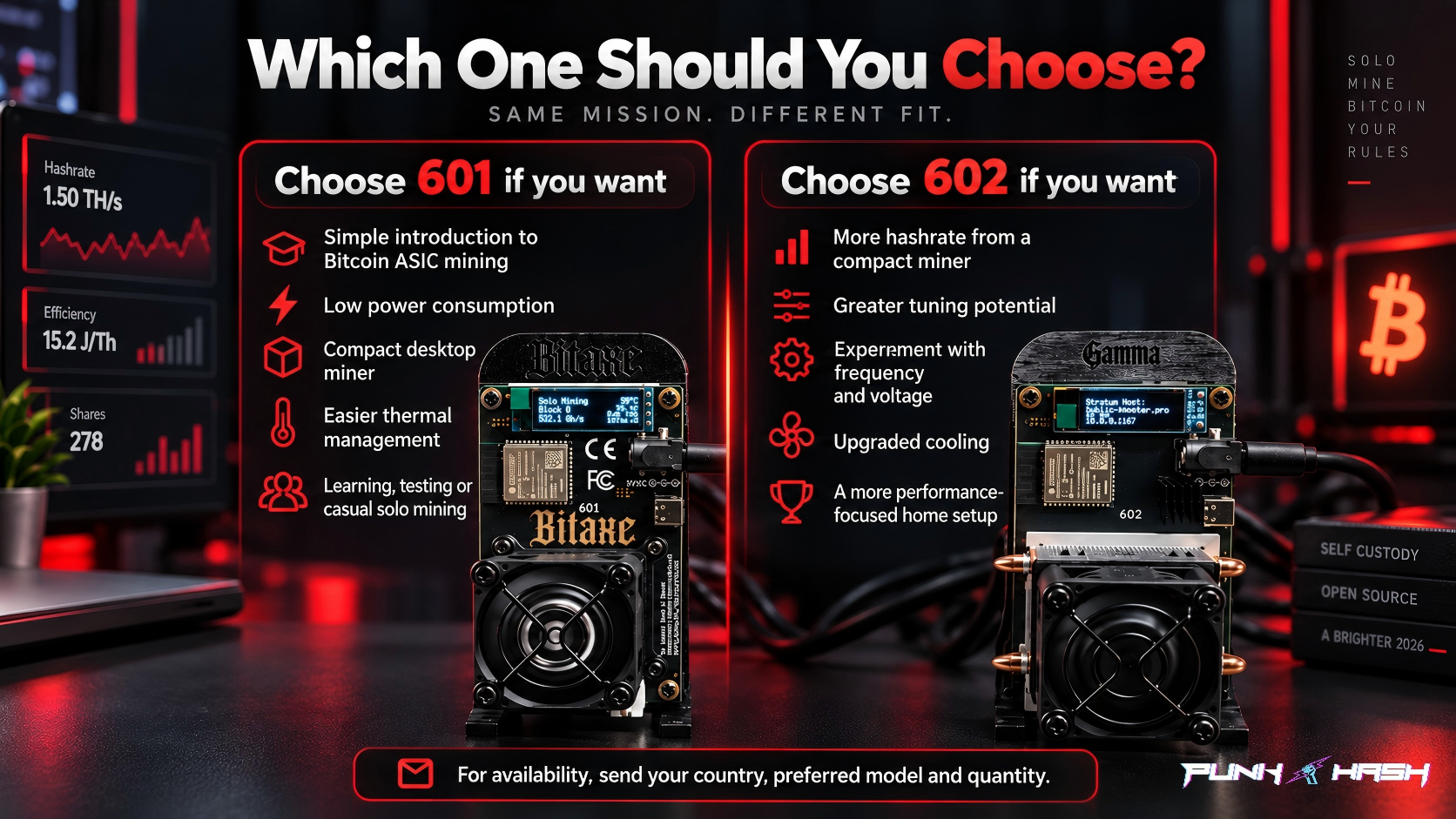
Choose the Bitaxe Gamma 601 if you want:
- a simple introduction to Bitcoin ASIC mining;
- low power consumption;
- a compact desktop miner;
- easier thermal management;
- a machine for learning, testing or casual solo mining.
Choose the Bitaxe Gamma 602 if you want:
- more hashrate from a compact miner;
- greater tuning potential;
- to experiment with frequency and voltage;
- upgraded cooling;
- a more performance-focused home mining setup.
Neither option should be evaluated as a guaranteed-return investment.
Solo Bitcoin mining is probabilistic, and mining conditions change with network difficulty, Bitcoin price, pool configuration and other variables.
Final Thoughts
The most interesting difference between the Bitaxe Gamma 601 and 602 is not simply the hashrate number.
It is the type of home miner each device suits.
The 601 is a strong entry point into open-source Bitcoin mining.
The 602 offers more room for users who want to experiment with performance, cooling and tuning.
For home mining, our recommendation is simple:
compare sustained hashrate, wall power, temperature, noise and stability—not only peak TH/s.
At PunkHash, we test home and solo mining hardware under real operating conditions, including hashrate, power consumption, temperature and stability.
For Bitaxe availability or help choosing a home Bitcoin miner, contact us with your country, preferred model and quantity.